Victorian Parlor Pump Organ
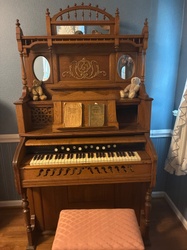
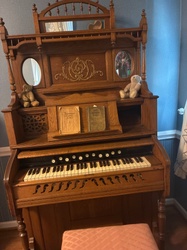
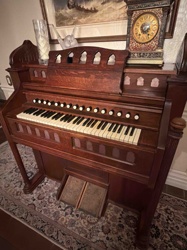
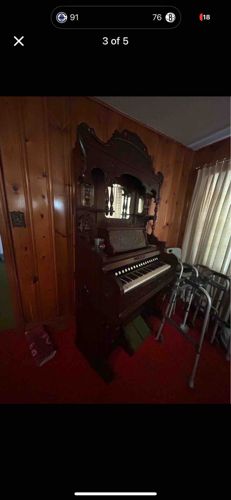
This is a late 19th-century Victorian-era pump organ, also known as a reed organ or harmonium. The instrument is housed in a tall, ornate upright case constructed primarily of dark-finished wood, likely walnut or mahogany. It features an elaborate high-back gallery or crest (splat) with decorative fretwork, turned spindles, and an integrated central mirror, which was a common aesthetic feature of the high Victorian style (circa 1880-1900). The keyboard consists of a single manual with ivory or celluloid natural keys and ebony sharps, though some yellowing and potential chipping are visible consistent with age. Above the keys, a row of white pull-stops is used to control various reed banks and tonal registers. The lower portion contains two carpeted foot pedals used to pump the internal bellows. While the finish appears largely intact with a deep patina, there are visible signs of surface wear, dust accumulation, and minor abrasions on the wood. The presence of intricate carvings and the complexity of the cabinetry suggest high-quality period craftsmanship. Mechanical condition cannot be determined from the photo, but organs of this age often require bellows re-leathering and internal cleaning to be playable.
AI-Generated Appraisal Disclaimer
Estimated Value
$400 - $800
Basic Information
Category
Antique Musical Instruments
Appraised On
January 10, 2026
Estimated Value
$400 - $800
Item Description
This is a late 19th-century Victorian-era pump organ, also known as a reed organ or harmonium. The instrument is housed in a tall, ornate upright case constructed primarily of dark-finished wood, likely walnut or mahogany. It features an elaborate high-back gallery or crest (splat) with decorative fretwork, turned spindles, and an integrated central mirror, which was a common aesthetic feature of the high Victorian style (circa 1880-1900). The keyboard consists of a single manual with ivory or celluloid natural keys and ebony sharps, though some yellowing and potential chipping are visible consistent with age. Above the keys, a row of white pull-stops is used to control various reed banks and tonal registers. The lower portion contains two carpeted foot pedals used to pump the internal bellows. While the finish appears largely intact with a deep patina, there are visible signs of surface wear, dust accumulation, and minor abrasions on the wood. The presence of intricate carvings and the complexity of the cabinetry suggest high-quality period craftsmanship. Mechanical condition cannot be determined from the photo, but organs of this age often require bellows re-leathering and internal cleaning to be playable.
Get Your Items Appraised
Instant estimates of your treasures with AI-powered instant appraisals