AI Appraisal Estimate

AI-generated estimates · not official valuations

From the user

What was submitted

Photo and notes provided by the user — not generated by AI

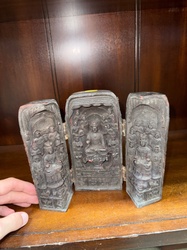
Submitted item photo
Submitted photo · May 27, 2026

User's notes

No additional notes provided.

AI analysis below

AI appraisal

AI analysis & estimate

AI-Generated · Verify before acting

Everything below is generated by AI for informational purposes only. AI can make mistakes — the AI may misidentify items or misattribute them (artist, maker, brand, designer, origin, era). This is not an official valuation and should not be used for insurance, sale, tax, estate, legal, or lending purposes — or any decision requiring a certified appraisal. It is not an authoritative claim about any person, brand, or rights holder — do not share or rely on it as a factual statement about a third party. Always consult qualified professionals before making financial decisions.

Read the full disclaimer

AI Identification

·Not independently authenticated·Verify before acting

Tibetan Buddhist Thangka Painting

Asian Religious Art

AI Estimated Value

·Not an official valuation·Verify before acting

$1,200 - $1,800 USD

As of May 27, 2026

AI Item Analysis

·AI can make mistakes·Verify before acting
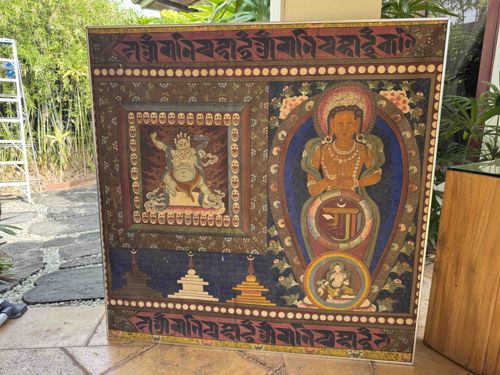
This is a large-format Tibetan Thangka painting featured in a square composition, likely executed on treated cotton canvas using mineral pigments. The artwork is divided into distinct iconographic zones. The right side prominently features a seated deity or bodhisattva, possibly Tara or a donor figure, identifiable by the orange-toned skin, elaborate jewelry, and green flowing robes, set within a vibrant blue mandorla. Below this figure is a sacred syllable or seed syllable (bija) inside a circular medallion. To the left, a smaller interior panel depicts a wrathful deity, possibly Mahakala or Vajrapani, surrounded by flames and a border of human skulls, signifying protection and the destruction of ego. The lower section illustrates three distinct stupas (chortens) in various colors (blue, white, and gold), representing the stages of the path to enlightenment. The top and bottom margins are heavily inscribed with Tibetan Uchen script, likely mantras or dedicatory prayers. The overall palette is rich and diverse, utilizing earthy reds, deep blues, and golds. The condition shows some surface wear and potential fading consistent with mid-to-late 20th-century origins, though the intricate linework suggests a high degree of traditional craftsmanship. The piece is currently displayed in a modern, thin metallic frame, which protects the edges of the textile.
AI Appraisal Report

·AI can make mistakes·Verify before acting
I have examined the digital representation of this Tibetan Thangka. The piece exhibits a complex, non-traditional narrative layout that suggests it may be a commissioned work or part of a specific lineage teaching series. The iconography, featuring a seated deity in a blue mandorla and a wrathful protector within a charnel ground motif, is executed with professional-grade mineral pigments on a finely prepared cotton support. The inclusion of three distinct chortens and extensive Uchen script adds significant ethnographic value. Regarding condition, I observe minor pigment loss and slight staining consistent with a mid-20th-century origin. The craftsmanship is above average, particularly in the precision of the script and the delicate shading of the robes. Current market demand for Tibetan art remains stable, with specific interest in pieces featuring unique iconographic arrangements such as this one. Comparable works of similar size and age typically realize between $1,000 and $2,500 at specialist auctions. Limitations: This appraisal is based solely on high-resolution imagery. A definitive valuation is hampered by the inability to physically inspect the verso for consecration marks or to test for modern synthetic binders in the pigments. Authenticity as an 'antiquity' cannot be fully verified without a textile analysis to confirm the weave density and fiber age. For full authentication, I recommend a physical inspection under UV light to detect restoration and the provision of provenance documentation regarding its acquisition from the Himalayan region.

Get your items appraised

Instant estimates of your treasures with AI-powered appraisals

Browse More Appraisals