These notes were written by the person who submitted this item. Appraiser.AI has not verified them, and the AI's identification and estimate may rely on them.
AI Estimated Value
Not an official valuation
$50-100
AI estimate as of July 17, 2025 · verify with a professional before acting
AI-Generated · Verify before acting
Everything on this page is generated by AI for informational purposes only. AI can make mistakes — the AI may misidentify items or misattribute them (artist, maker, brand, designer, origin, era). This is not an official valuation and should not be used for insurance, sale, tax, estate, legal, or lending purposes — or any decision requiring a certified appraisal. It is not an authoritative claim about any person, brand, or rights holder — do not share or rely on it as a factual statement about a third party. Always consult qualified professionals before making financial decisions.
This analysis also relies on unverified notes provided by the user, which may be incomplete or inaccurate and could affect the result.
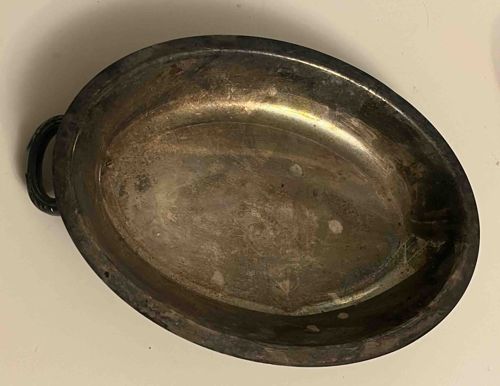
The item is an oval-shaped serving dish, likely a gratin or casserole dish, crafted from what appears to be silver-plated metal, given its tarnished appearance and the visible underlying yellowing in some areas. Its overall dimensions seem to be medium to large, suitable for serving multiple portions. The dish features an elongated oval basin with gently slopping sides and a flattened rim. The exterior surface shows significant tarnishing, presenting a dark, oxidized patina that ranges from dark gray to black, unevenly distributed. The interior, while also tarnished, exhibits lighter patches of original silver color, particularly in the center, and some areas where the plating may have worn thin, revealing a brassy or yellowish base metal. Several circular spots of lighter color are visible on the interior surface, which could indicate areas where polish was applied, or perhaps remnants of food or mineral deposits. The dish features two ornate, dark-colored handles, one on each end of the oval. These handles appear to be made perhaps of a dark metal or ebonized wood/resin, contrasting with the silver plate of the dish itself. Their design suggests a decorative, possibly Neo-classical or Victorian influence, with visible ridges or scrollwork. The construction seems robust, indicating a level of craftsmanship expected of such serveware. No distinct maker's marks or signatures are discernible from the provided image, but the style suggests it could be from the early to mid-20th century. The condition indicates heavy use and a lack of recent polishing, contributing to its strong, uneven patina. The presence of matching handles on both sides indicates thoughtful design for ease of transport and serving.
AI Appraisal Report
I have examined the provided image of the Oval Silver-Plated Serving Dish with Dark Handles. Based on the visual evidence, this piece appears to be a genuine silver-plated serving dish, likely dating from the early to mid-20th century, consistent with its design and apparent manufacturing techniques. The tarnishing is significant and uneven, suggesting prolonged exposure and lack of recent polishing. While the interior shows wear, revealing a brassy base metal in areas, this is common for older silver-plated items that have seen frequent use. The dark, possibly ebonized wood or resin handles with their decorative elements add a significant aesthetic appeal and contrast, enhancing its appearance.
From a market perspective, silver-plated serveware often falls into a broad demand category, with the value heavily influenced by condition, maker, and intricate design. This piece, while showing wear, possesses a charming antique aesthetic. The absence of discernible maker's marks is a limiting factor in determining a higher value, as established makers often command premium prices. Comparables in similar condition without prominent maker's marks typically retail in the lower to mid-range for silver-plated serveware. The rarity is moderate; while not unique, this specific design and condition present a typical example of its era.
Factors impacting value include the heavy tarnish, which would require professional cleaning to restore luster, affecting immediate display readiness. The wear to the silver plating on the interior also impacts its overall condition from an aesthetic standpoint. For full authentication and to ascertain the exact material compositions of the handles or to locate any hidden maker's marks, a physical in-person examination, including hands-on inspection and potentially specific gravity testing or surface analysis for the handles, would be essential. Without this, I cannot definitively confirm anything beyond what is visually apparent in the photograph. This physical inspection would also allow for a more precise assessment of the extent of plating loss and any potential structural issues not visible in the image.