AI estimate as of August 26, 2025 · verify with a professional before acting
AI-Generated · Verify before acting
Everything on this page is generated by AI for informational purposes only. AI can make mistakes — the AI may misidentify items or misattribute them (artist, maker, brand, designer, origin, era). This is not an official valuation and should not be used for insurance, sale, tax, estate, legal, or lending purposes — or any decision requiring a certified appraisal. It is not an authoritative claim about any person, brand, or rights holder — do not share or rely on it as a factual statement about a third party. Always consult qualified professionals before making financial decisions.
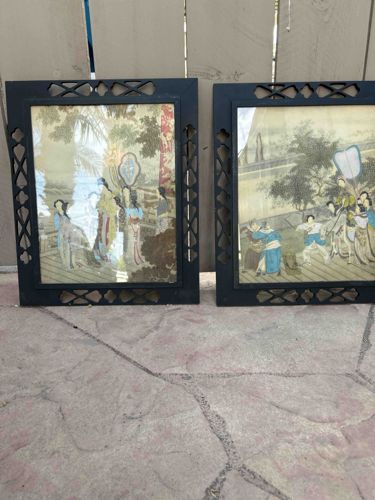
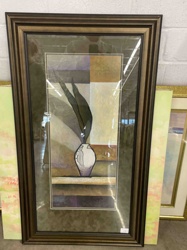
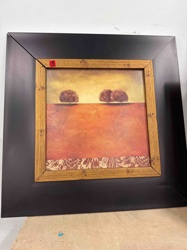
This is a pair of framed panels featuring what appear to be hand-painted or possibly embroidered scenes depicting figures in traditional East Asian attire within garden or palace settings. Each panel is enclosed within a rectangular frame constructed from dark wood, possibly lacquered or stained black. The frames exhibit decorative openwork elements, particularly at the top and bottom borders, featuring a repeating 'X' or 'hourglass' pattern flanked by quatrefoil-like shapes at the corners. The sides of the frames also show vertical cut-outs or openings, adding to the decorative appeal. The scenes themselves portray multiple figures, likely depicting daily life or ceremonial activities. Colors appear somewhat muted, suggesting age or a deliberate aesthetic choice. One panel clearly shows figures gathered under trees, while the other shows a similar setting with various individuals, some holding fans. The artwork itself is housed under what seems to be glass or a clear protective covering, which causes some reflection in the image. Although the exact medium (paint, textile, print) is not definitively discernible from the provided image, the textured appearance in some areas suggests a textile base (e.g., silk painting or embroidery) or fine brushstrokes. There are no visible maker's marks or signatures in the image. The condition appears fair, with some visible dust or possible oxidation on the surface of the artwork in the left panel, and the frames show minor wear consistent with age and handling. Cracking on the stone ground beneath suggests they may be older pieces, possibly from the early to mid-20th century or earlier, given their traditional style and apparent craftsmanship. The overall quality of craftsmanship in the frames, particularly the intricate cut-outs, suggests a level of deliberate artistry in their construction.
AI Appraisal Report
Upon visual examination of the provided image, I assess this pair of framed East Asian figurative panels. The frames, crafted from dark wood with intricate openwork elements and vertical cut-outs, suggest a deliberate artistic effort in their construction, hinting at a potential early to mid-20th-century origin. The scenes, depicting figures in traditional attire within garden or palace settings, appear to be either hand-painted or embroidered, with a textured quality visible in some areas, leaning towards a textile medium like silk. The muted color palette is consistent with age or a traditional aesthetic.
In terms of condition, I observe fair wear consistent with age, including what appears to be dust or oxidation on the artwork's surface in the left panel and minor wear on the frames. The overall craftsmanship of the frames is a significant positive factor.
Determining authenticity from images alone is highly challenging. Without direct physical inspection, I cannot confirm the exact medium (painting vs. embroidery), the age, or the origin. The absence of visible maker's marks or signatures limits immediate authentication. For a full authentication, I would require in-person examination to verify the material, artistic technique, and precise age. Furthermore, provenance documentation would be essential to establish a clear history of ownership, and scientific testing could be employed to analyze materials and pigments for a more precise dating.
Considering current market conditions for decorative East Asian art, pieces of this nature, if confirmed to be original vintage artworks, generally see stable demand. Comparables would include similar framed silk paintings or embroideries from the specified period. The primary factors impacting value would be the authenticity of the artwork (hand-painted/embroidered vs. print), the specific artist if identifiable, and the exact period of creation. Rarity is difficult to assess without further information, but well-preserved sets of this type are less common than single pieces.
Given the aesthetic appeal and apparent craftsmanship, and assuming they are original vintage pieces, my valuation reflects their decorative value in today's market, balanced with the limitations of remote assessment.