AI estimate as of August 26, 2025 · verify with a professional before acting
AI-Generated · Verify before acting
Everything on this page is generated by AI for informational purposes only. AI can make mistakes — the AI may misidentify items or misattribute them (artist, maker, brand, designer, origin, era). This is not an official valuation and should not be used for insurance, sale, tax, estate, legal, or lending purposes — or any decision requiring a certified appraisal. It is not an authoritative claim about any person, brand, or rights holder — do not share or rely on it as a factual statement about a third party. Always consult qualified professionals before making financial decisions.
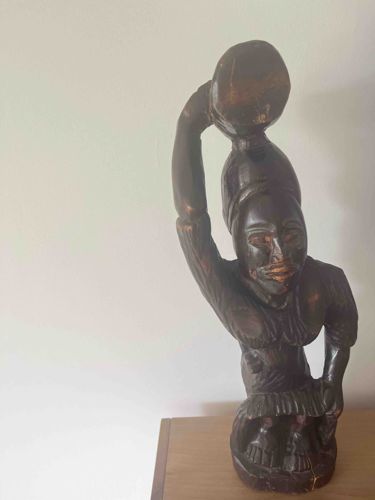
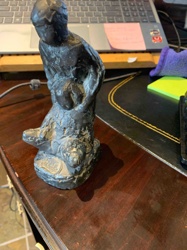
This is a hand-carved wooden sculpture depicting a female figure carrying a vessel on her head. The sculpture appears to be crafted from a single piece of dark wood, likely ebony or a similar dense hardwood, given its dark, rich brown to almost black coloration and noticeable weight. The figure is rendered in a somewhat elongated, stylized form, common in certain African and tribal art traditions. She is shown in a dynamic pose, with one arm raised to support the vessel balanced on her head, suggesting movement and strength. Her facial features are carved with simplicity; visible details include carved eyes, a nose, and lips, which show traces of a lighter, possibly coppery-toned pigment, indicating highlights or painted details. The surface of the wood reveals distinct carving marks, suggesting hand-tooling. Visible condition issues include minor scuffs and possibly some light surface wear consistent with age and handling. There appears to be a hairline crack or natural wood split near the base of the sculpture on what would be the viewer's right side, indicative of the material's natural characteristics or environmental changes. The base is an integral part of the carving, featuring rudimentary, chiseled details that form a skirt-like lower garment or perhaps represent foundational elements. The piece exudes a rustic, artisanal quality, suggesting it is either a traditional folk art piece or an item produced for the tourist market, likely in the mid to late 20th century. The craftsmanship, while not hyper-realistic, demonstrates an understanding of form and balance, presenting a strong visual presence.
AI Appraisal Report
Based on my visual examination of the African Figural Wood Carving of a Woman Carrying a Pot, I've assessed its condition, authenticity, and potential market value. The piece appears to be hand-carved from a dense, dark hardwood, likely ebony or a similar species, exhibiting typical hand-tooling marks. The stylized form, dynamic pose, and simple facial features are characteristic of certain African tribal or folk art traditions. Condition-wise, I note minor scuffs and surface wear consistent with age and handling. A hairline crack or natural wood split near the base is visible, which is common in wood carvings due to age, environmental changes, or inherent material characteristics; this is generally not a significant detractor unless it compromises structural integrity. The use of a lighter, coppery-toned pigment for facial highlights is an interesting detail. Authenticity is challenging to definitively confirm from images alone. While it possesses the characteristics of a genuine hand-carved item and not a mass-produced replica, determining its exact origin (e.g., specific tribe or region) or whether it's an authentic tribal piece versus a tourist market item from the mid-to-late 20th century, which often mimicked traditional styles, is difficult. Without provenance documentation or a physical inspection to assess the wood's age and carving techniques more closely, I cannot verify if it's an older, more significant ethnographic piece or a more recent decorative art object. The demand for such carvings remains steady, particularly for well-executed examples. Comparable pieces in the market, especially those without definitive historical provenance, typically fall within a modest range. The primary factors impacting value here are the lack of authenticated origin, the possibility of it being a tourist piece, and the minor condition issues. For full authentication, I would require in-person examination to assess carving precision, wood grain, patination, and tool marks under magnification, along with any provenance documentation. Scientific dating of the wood could also provide valuable insights into its age.