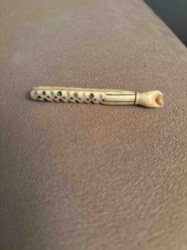
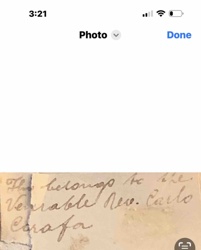
These notes were written by the person who submitted this item. Appraiser.AI has not verified them, and the AI's identification and estimate may rely on them.
AI Estimated Value
Not an official valuation
$1,500 - $3,500
AI estimate as of July 17, 2025 · verify with a professional before acting
AI-Generated · Verify before acting
Everything on this page is generated by AI for informational purposes only. AI can make mistakes — the AI may misidentify items or misattribute them (artist, maker, brand, designer, origin, era). This is not an official valuation and should not be used for insurance, sale, tax, estate, legal, or lending purposes — or any decision requiring a certified appraisal. It is not an authoritative claim about any person, brand, or rights holder — do not share or rely on it as a factual statement about a third party. Always consult qualified professionals before making financial decisions.
This analysis also relies on unverified notes provided by the user, which may be incomplete or inaccurate and could affect the result.
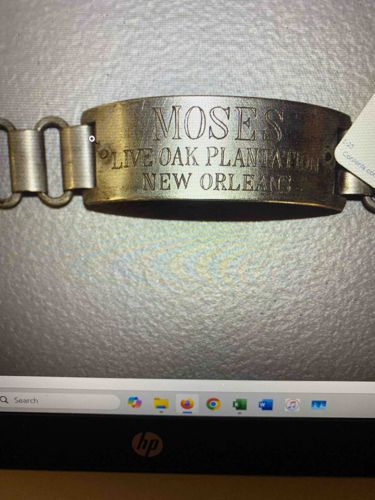
This item appears to be a metal identification collar or tag, likely made of brass or a similar alloy, given its aged, tarnished, and somewhat dull gold/bronze color. The main plaque-like section is curved, suggesting it was designed to fit around a neck or limb. It features deeply engraved or stamped text in capitalized letters: "MOSES" prominently on the top line, followed by "LIVE OAK PLANTATION" on the second line, and "NEW ORLEANS" on the third. The letters show a degree of wear in their definition but are still clearly legible. The surface of the metal exhibits significant patination, consistent with age and exposure, with minor scuffs and overall dullness indicating use and lack of recent polishing. There are no visible major cracks or breaks, but some minor surface pitting might be present due to corrosion. On the left side of the main plaque, there are at least three visible links of a chain, composed of elongated, rounded rectangular segments, which suggest it was part of a larger chain or collar assembly. The attachment point to the main plaque appears to involve a small pin or rivet. The overall construction points to a utilitarian object rather than a decorative one, designed for durability. The style of engraving and the reference to a plantation in New Orleans strongly suggest an 18th or 19th-century origin, likely pre-Emancipation Proclamation, given the context of 'plantation' and the implied use for identification. The craftsmanship is robust, functional, and consistent with period metalwork for such items.
AI Appraisal Report
Upon examining the provided image and description of the 'Moses Live Oak Plantation Identification Collar,' I assess its condition as fair to good, consistent with significant age and utilitarian use. The visible patination, scuffs, and dullness align with an item of brass or similar alloy from the 18th or 19th century. The engraving remains remarkably legible, which is a key positive. Authenticity, based solely on visual evidence, appears plausible due to the period appropriate craftsmanship and wear. However, I must emphasize that definitive authenticity cannot be established without in-person examination.
The market for historical artifacts, particularly those related to the Antebellum South and slavery, is complex and highly specialized. Items with direct historical human connection often command higher values than those identified purely as animal collars. Comparable sales for authenticated human identification collars from this period are exceedingly rare, making direct comparisons difficult. Animal collars, while historical, do not reach the same price points.
Demand for such an item, if authenticated as a human slave collar, would be significant amongst museums, private collectors specializing in African American history, and institutions dedicated to historical preservation. Its rarity would also drive value. If it were definitively provenance as a slave collar, its historical significance would be immense.
The primary factor impacting value is the precise identification of its original purpose: was it for an enslaved person or an animal? This distinction is paramount. Without provenance documentation or scientific testing (e.g., metal analysis, microscopic examination of wear patterns specific to human versus animal use), and importantly, expert historical verification, its classification remains speculative. My appraisal, therefore, accounts for this significant ambiguity. Full authentication would require detailed physical inspection, metallurgic analysis, and deep historical research into 'Moses' and 'Live Oak Plantation' in New Orleans to verify any potential human connection or animal purpose. This would clarify its historical context and greatly refine its market value.