AI Appraisal Estimate

AI-generated estimates · not official valuations

From the user

What was submitted

Photo and notes provided by the user — not generated by AI

Submitted item photo
Submitted photo · June 3, 2026

User's notes

No additional notes provided.

AI analysis below

AI appraisal

AI analysis & estimate

AI-Generated · Verify before acting

Everything below is generated by AI for informational purposes only. AI can make mistakes — the AI may misidentify items or misattribute them (artist, maker, brand, designer, origin, era). This is not an official valuation and should not be used for insurance, sale, tax, estate, legal, or lending purposes — or any decision requiring a certified appraisal. It is not an authoritative claim about any person, brand, or rights holder — do not share or rely on it as a factual statement about a third party. Always consult qualified professionals before making financial decisions.

Read the full disclaimer

AI Identification

·Not independently authenticated·Verify before acting

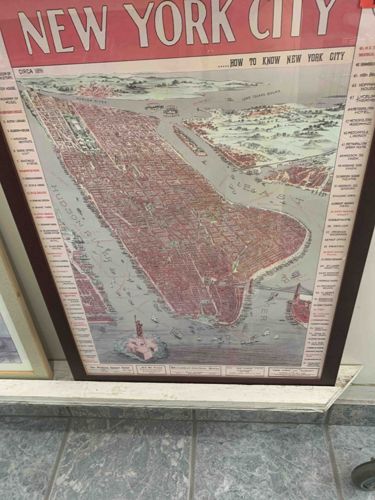
New York City Circa 1899 "How to Know New York City" Framed Map

Map / Wall Art

AI Estimated Value

·Not an official valuation·Verify before acting

$75-125

As of June 3, 2026

AI Item Analysis

·AI can make mistakes·Verify before acting
The item is a framed historical map of New York City, likely a reproduction or original print, titled "NEW YORK CITY" at the top, followed by "... HOW TO KNOW NEW YORK CITY." The map itself depicts Manhattan and surrounding boroughs and waterways, prominently featuring the Hudson River to the west and what appears to be the East River to the east. The landmasses, particularly Manhattan, are depicted in a reddish-brown hue, indicating built-up areas or city blocks, contrasting with the light blue-grey of the water. Small details like boats are visible in the water, and the Statue of Liberty is clearly depicted in the harbor area. The overall style suggests an isometric or bird's-eye view rather than a standard flat projection, giving a three-dimensional impression of the city. The top left corner of the map includes text "CIRCA 1899," indicating its estimated age or the period it represents. Along the left and right margins of the map, there are numbered lists of points of interest, further adding to its informative nature. The map is housed within a dark brown wooden frame, which shows some visible wear and tear, including scuffs and possibly some chipping, particularly visible at the bottom left corner where the frame meets the white molding. The paper or print material of the map itself appears to have some discoloration or foxing, consistent with age or exposure, and some creasing or rippling may be present, though difficult to ascertain definitively from the image. The colors, while somewhat muted, retain a vintage appeal. There are no readily discernible manufacturer's marks or specific artist signatures visible in the provided image.
AI Appraisal Report

·AI can make mistakes·Verify before acting
Upon examining the provided image of the framed map, titled "How to Know New York City" and dated "Circa 1899," I have conducted a preliminary appraisal. The item is an attractive bird's-eye view map of Manhattan and its surroundings, a popular style for the period. The key question affecting value is whether this is an original 1899 lithograph or a later reproduction. Visual inspection of the image reveals some signs of aging, such as potential foxing or discoloration on the paper and wear on the dark wooden frame. However, these can be artificially created, and the print's details lack the sharpness often seen in original period lithographs, suggesting it is more likely a modern decorative reproduction. The market for authentic late 19th-century New York City maps is strong, with original prints fetching several hundred to over a thousand dollars depending on the cartographer, publisher, and condition. In contrast, the market for reproductions is significantly lower. The demand for vintage-style New York decor is high, which gives this piece decorative value regardless of its authenticity. Critically, a definitive assessment cannot be made from an image alone. A full authentication would require physical examination to assess the paper type, printing method (e.g., lithography vs. modern offset printing), and any publisher's marks. Examining the print outside of its frame is essential to check the margins and paper condition more closely. Without provenance or physical inspection, the item must be appraised as a decorative reproduction.

Get your items appraised

Instant estimates of your treasures with AI-powered appraisals

Browse More Appraisals