Tibetan or Nepalese Green Tara Bronze Statue
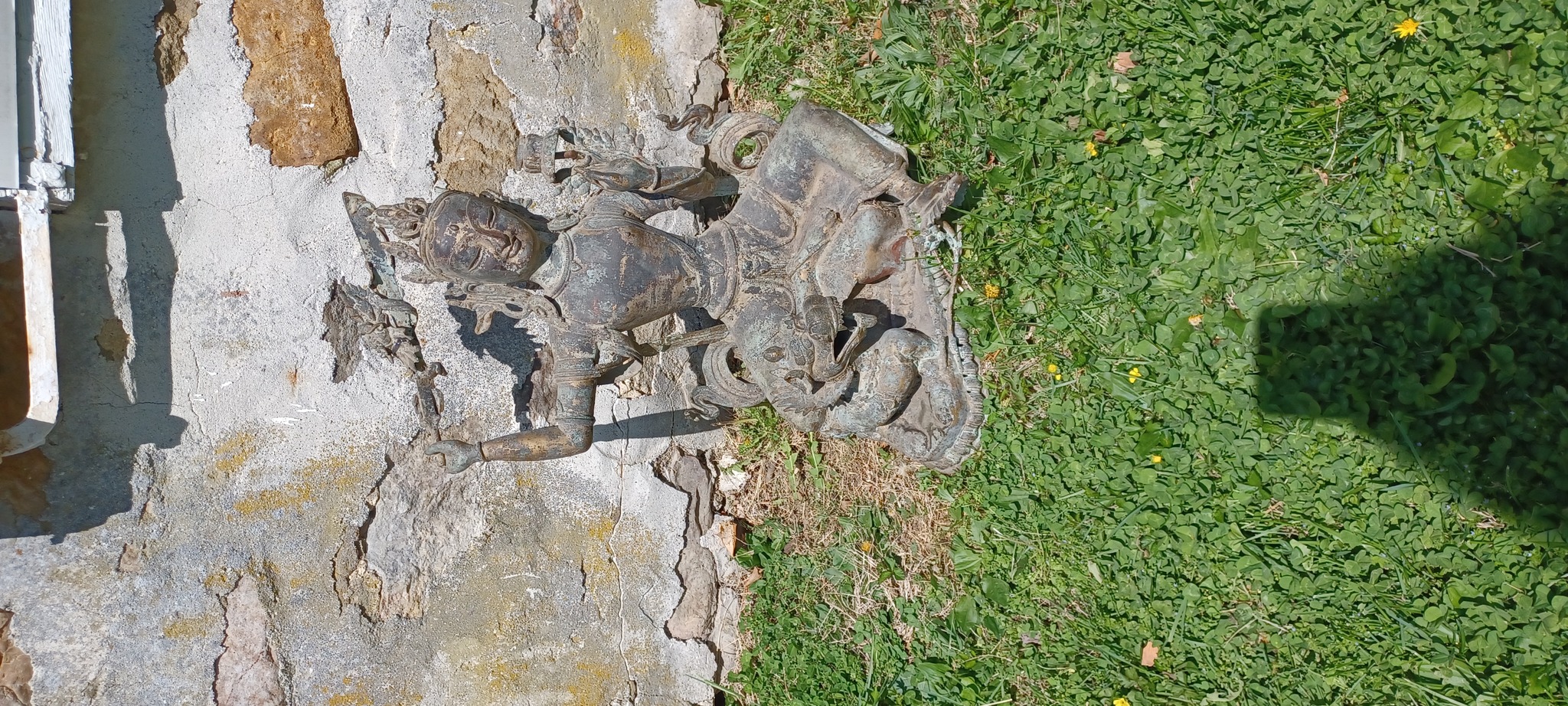
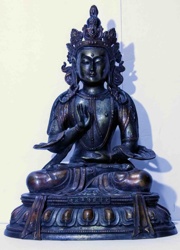
This is a cast metal statue, likely bronze or a high-copper alloy, depicting the Buddhist deity Green Tara (Syamatara) in a traditional Lalitasana pose (position of royal ease) on a lotus pedestal. The figure is characterized by elaborate adornments, including a five-pointed foliate crown, heavy necklaces, armbands, and flowing celestial scarves that frame the body. Her right hand is extended in the Varada Mudra (gesture of boon-granting), while the left hand is held at the heart in the Vitarka Mudra (gesture of discussion/teaching). Small lotus blossoms are visible rising near her shoulders. The material exhibits a heavy, multi-layered patina with significant green oxidation (verdigris) and encrustation throughout, suggesting long-term exposure to moisture or burial. This surface texture obscures fine facial details but highlights the depth of the casting. The construction appears to be lost-wax casting, typical of Himalayan or Indo-Tibetan craftsmanship. One of the crown's points appears damaged or bent, and there is a noticeable structural break or separation where the figure meets the lotus base on the left side. The style is reminiscent of 18th to 19th-century Newari or Tibetan devotional art, though the heavy weathering makes precise dating difficult without physical examination of the base plate and core.
AI-Generated Appraisal Disclaimer
Estimated Value
$400 - $700
Basic Information
Category
Asian Antiques / Buddhist Art
Appraised On
April 28, 2026
Estimated Value
$400 - $700
Item Description
This is a cast metal statue, likely bronze or a high-copper alloy, depicting the Buddhist deity Green Tara (Syamatara) in a traditional Lalitasana pose (position of royal ease) on a lotus pedestal. The figure is characterized by elaborate adornments, including a five-pointed foliate crown, heavy necklaces, armbands, and flowing celestial scarves that frame the body. Her right hand is extended in the Varada Mudra (gesture of boon-granting), while the left hand is held at the heart in the Vitarka Mudra (gesture of discussion/teaching). Small lotus blossoms are visible rising near her shoulders. The material exhibits a heavy, multi-layered patina with significant green oxidation (verdigris) and encrustation throughout, suggesting long-term exposure to moisture or burial. This surface texture obscures fine facial details but highlights the depth of the casting. The construction appears to be lost-wax casting, typical of Himalayan or Indo-Tibetan craftsmanship. One of the crown's points appears damaged or bent, and there is a noticeable structural break or separation where the figure meets the lotus base on the left side. The style is reminiscent of 18th to 19th-century Newari or Tibetan devotional art, though the heavy weathering makes precise dating difficult without physical examination of the base plate and core.
Related Tags
Explore similar items and categories:
Get Your Items Appraised
Instant estimates of your treasures with AI-powered instant appraisals