Japanese Arita Blue and White Octagonal Porcelain Charger
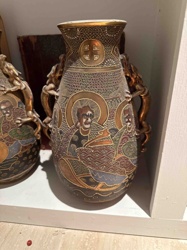
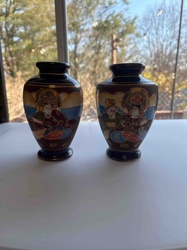
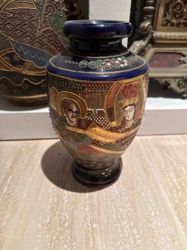
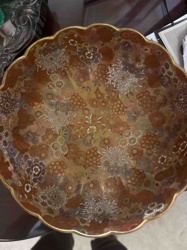
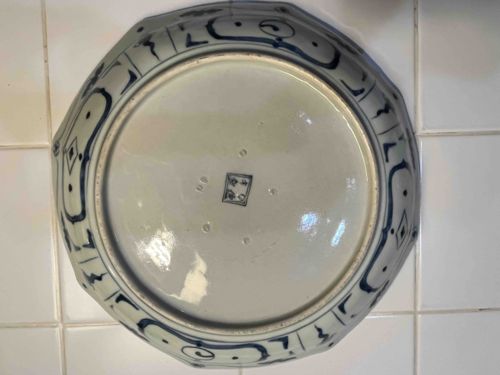
This is a large, octagonal-shaped Japanese porcelain charger, likely originating from the Arita kilns. The piece features traditional underglaze blue decoration against a greyish-white ground. The back of the charger displays a wide, unglazed foot ring showing a compact, white porcelain body. The underside of the rim is decorated with stylized floral or geometric scrollwork and cartouches containing trellis patterns, typical of the Edo or Meiji transition periods. A notable feature is the presence of five visible spur marks (stilt marks) arranged in a circular configuration around the central mark, which were used to support the piece during firing to prevent it from sagging. The center of the base bears a square four-character apocryphal Chenghua mark (Da Ming Cheng Hua Nian Zhi), which was a common practice in 19th-century Japanese ceramics to honor earlier Chinese Ming dynasty craftsmanship. Regarding condition, there is a prominent vertical hairline crack running from the top edge toward the center, along with several smaller chips and glaze abrasions along the scalloped rim. The glaze shows characteristic pinholes and cooling pips, and the foot ring exhibits expected shelf wear and oxidation consistent with age. This piece reflects the 'Kraak' style of export-influenced Japanese porcelain, likely dating to the late 19th century.
AI-Generated Appraisal Disclaimer
Estimated Value
$400 - $600
Basic Information
Category
Asian Antiques - Japanese Ceramics
Appraised On
January 16, 2026
Estimated Value
$400 - $600
Item Description
This is a large, octagonal-shaped Japanese porcelain charger, likely originating from the Arita kilns. The piece features traditional underglaze blue decoration against a greyish-white ground. The back of the charger displays a wide, unglazed foot ring showing a compact, white porcelain body. The underside of the rim is decorated with stylized floral or geometric scrollwork and cartouches containing trellis patterns, typical of the Edo or Meiji transition periods. A notable feature is the presence of five visible spur marks (stilt marks) arranged in a circular configuration around the central mark, which were used to support the piece during firing to prevent it from sagging. The center of the base bears a square four-character apocryphal Chenghua mark (Da Ming Cheng Hua Nian Zhi), which was a common practice in 19th-century Japanese ceramics to honor earlier Chinese Ming dynasty craftsmanship. Regarding condition, there is a prominent vertical hairline crack running from the top edge toward the center, along with several smaller chips and glaze abrasions along the scalloped rim. The glaze shows characteristic pinholes and cooling pips, and the foot ring exhibits expected shelf wear and oxidation consistent with age. This piece reflects the 'Kraak' style of export-influenced Japanese porcelain, likely dating to the late 19th century.
Get Your Items Appraised
Instant estimates of your treasures with AI-powered instant appraisals