AI Appraisal Estimate

AI-generated estimates · not official valuations

From the user

What was submitted

Photo and notes provided by the user — not generated by AI

Submitted item photo
Submitted photo · May 28, 2026

User's notes

No additional notes provided.

AI analysis below

AI appraisal

AI analysis & estimate

AI-Generated · Verify before acting

Everything below is generated by AI for informational purposes only. AI can make mistakes — the AI may misidentify items or misattribute them (artist, maker, brand, designer, origin, era). This is not an official valuation and should not be used for insurance, sale, tax, estate, legal, or lending purposes — or any decision requiring a certified appraisal. It is not an authoritative claim about any person, brand, or rights holder — do not share or rely on it as a factual statement about a third party. Always consult qualified professionals before making financial decisions.

Read the full disclaimer

AI Identification

·Not independently authenticated·Verify before acting

Collection of Antique Crosscut Saws

Tools/Decor

AI Estimated Value

·Not an official valuation·Verify before acting

$400-600

As of May 28, 2026

AI Item Analysis

·AI can make mistakes·Verify before acting
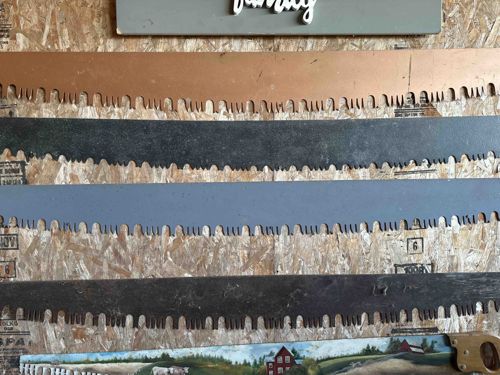
The image displays four antique or vintage crosscut saws, specifically the blade sections, with one additional saw visible at the bottom that appears to be decorative. These are primarily 'two-man' crosscut saws, characterized by their substantial length and the distinctive raker and cutter teeth pattern designed for efficient timber felling and bucking. Each saw blade is crafted from steel, exhibiting varying degrees of corrosion and patina, indicating their age and past use. The top-most saw has a reddish-brown, possibly copper-toned or heavily rusted, finish. The second and third saws from the top are dark gray to black, suggesting original bluing or heavy oxidation, with the third one appearing to have some light blue or grey paint. The fourth saw from the top is a very dark, almost black, color and shows significant surface wear. The teeth on all these functional saws feature the typical alternating cutter and raker design, with the rakers being shorter and U-shaped to clear sawdust, and the cutters being sharper for slicing wood fibers. The teeth show some wear and irregularities, consistent with their age and use. The bottom-most saw stands apart as it is clearly painted with a pastoral landscape scene, featuring a red barn, a house, and trees, suggesting it has been repurposed as a decorative piece rather than a functional tool. The handle of this decorative saw, made of wood, is partially visible and appears lighter in tone, possibly a natural wood finish. The background against which these saws are displayed is oriented strand board (OSB), which serves as a rustic backdrop.
AI Appraisal Report

·AI can make mistakes·Verify before acting
Upon examining the collection of five antique crosscut saws, I note varying conditions and purposes. The top four saws exhibit significant age and use, characterized by their steel blades with varying degrees of corrosion and patina. The top-most saw's reddish-brown finish suggests heavy rust, while the others are dark gray to black, indicating oxidation or bluing. Their authentic two-man crosscut saw design, with alternating cutter and raker teeth, confirms their historical use as functional timber tools. Demand for these functional antique tools is modest but steady among collectors, historians, and those seeking rustic decorative pieces. Their value is influenced by condition; while these show wear, their completeness as blades adds to their appeal. The primary limitation to a definitive authentication from images alone is the inability to assess blade integrity, sharpness of teeth beyond visible wear, and the material composition of the steel. An in-person examination would allow for tactile assessment of pitting, structural soundness, and detailed identification of any maker’s marks or stamps, which are not discernible here through visual inspection. Provenance documentation, such as records of ownership or origin, would significantly enhance their historical and market value. The final saw is clearly a decorative piece, painted with a landscape. While its original functionality is secondary, its repurposed aesthetic appeal makes it suitable for home decor.

Get your items appraised

Instant estimates of your treasures with AI-powered appraisals

Browse More Appraisals