AI Appraisal Estimate

AI-generated estimates · not official valuations

From the user

What was submitted

Photo and notes provided by the user — not generated by AI

Submitted item photo
Submitted photo · June 30, 2026

User's notes

No additional notes provided.

AI analysis below

AI appraisal

AI analysis & estimate

AI-Generated · Verify before acting

Everything below is generated by AI for informational purposes only. AI can make mistakes — the AI may misidentify items or misattribute them (artist, maker, brand, designer, origin, era). This is not an official valuation and should not be used for insurance, sale, tax, estate, legal, or lending purposes — or any decision requiring a certified appraisal. It is not an authoritative claim about any person, brand, or rights holder — do not share or rely on it as a factual statement about a third party. Always consult qualified professionals before making financial decisions.

Read the full disclaimer

AI Identification

·Not independently authenticated·Verify before acting

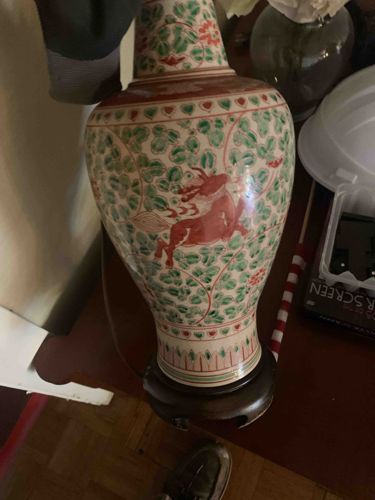
Chinese Wucai Style Porcelain Baluster Vase with Qilin Motif

Asian Art / Ceramics & Porcelain

AI Estimated Value

·Not an official valuation·Verify before acting

$450 - $700

As of June 30, 2026

AI Item Analysis

·AI can make mistakes·Verify before acting
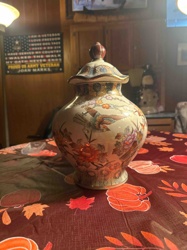
This is a large, hand-painted porcelain vase in the traditional Chinese baluster or 'Yuhuchunping' silhouette, though slightly more elongated. It features a high shoulder, a tapered neck, and a wide body that sits atop a carved dark wood (likely rosewood or mahogany) circular decorative stand. The vase is decorated in a style reminiscent of 'Wucai' or 'Famille Verte' palettes, predominantly featuring iron-red and green enamels on a white glazed ground. The central motif depicts a 'Qilin' (a mythical hooved chimerical creature) in a dynamic, galloping pose. The background is densely populated with a repeating 'Mille-Fleurs' or lush foliage pattern consisting of green leaves and delicate red blossoms. A band of stylized red lotus petals or ju-yi heads circles the shoulder, while linear and floral borders decorate the foot and neck. The brushwork shows a level of decorative hand-craftsmanship typical of late 19th or mid-20th-century export pieces. Regarding condition, there is visible age-related surface wear and light pitting in the glaze, though no major chips or structural cracks are immediately apparent from this angle. The glaze has a slight sheen indicative of high-fired porcelain. The overall style suggests a mid-20th-century reproduction of a Ming or Qing dynasty original, intended for the global decorative arts market.
AI Appraisal Report

·AI can make mistakes·Verify before acting
Based on my visual examination of this Wucai-style baluster vase, I have identified it as a mid-20th-century decorative production, likely intended for the export market. The central Qilin motif and dense foliate ground are rendered with a bold palette of iron-red and copper-green enamels. While the piece captures the spirit of the Kangxi period, the brushwork lacks the calligraphic precision and depth of tonality found in 17th-century originals. The surface exhibits light pitting and glaze wear consistent with age, though the high-gloss finish suggests modern kiln firing techniques. The market for mid-century Chinese decorative arts remains stable, driven by interior designers and collectors of 'Chinoiserie.' Comparables from the Republic Period to the 1960s typically sell within the mid-triple-digit range. The presence of the carved hardwood stand adds approximately $50-$100 in decorative value to the overall lot. Rarity is considered low, as these were produced in significant quantities for global distribution. Critically, a definitive appraisal is limited by the digital nature of this inspection. I cannot examine the foot rim for paste consistency, check the base for an apocryphal reign mark, or use UV light to detect professional restorations. To confirm the date of production and rule out a much earlier provenance, an in-person examination of the foot rim's 'oily' texture—characteristic of true period porcelain—and documented provenance would be required. Scientific testing such as thermoluminescence could offer a definitive age, though the current valuation does not warrant such cost.

Get your items appraised

Instant estimates of your treasures with AI-powered appraisals

Browse More Appraisals