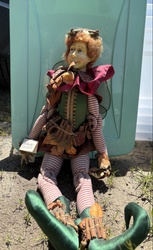
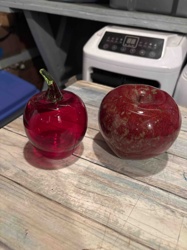
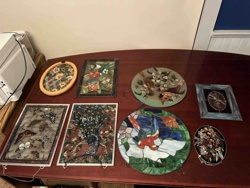
AI estimate as of September 22, 2025 · verify with a professional before acting
AI-Generated · Verify before acting
Everything on this page is generated by AI for informational purposes only. AI can make mistakes — the AI may misidentify items or misattribute them (artist, maker, brand, designer, origin, era). This is not an official valuation and should not be used for insurance, sale, tax, estate, legal, or lending purposes — or any decision requiring a certified appraisal. It is not an authoritative claim about any person, brand, or rights holder — do not share or rely on it as a factual statement about a third party. Always consult qualified professionals before making financial decisions.
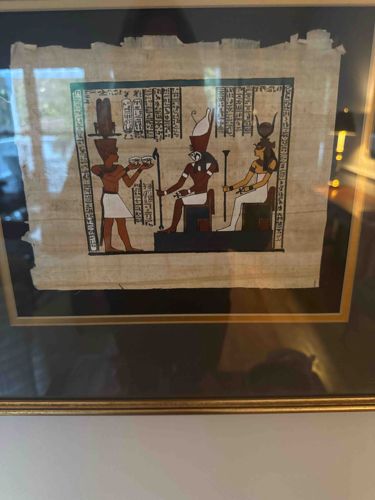
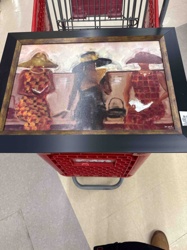
The item is a framed piece of Egyptian papyrus art, depicting a scene with three figures rendered in the distinctive ancient Egyptian style. The central figure, seated on a throne, appears to be a deity, likely Osiris, given his white crown (Hedjet) combined with the atef crown, and holding a crook and flail—symbols of kingship and fertility. To his right (viewer's left), another figure stands, seemingly presenting an offering, dressed in a white kilt and wearing a double crown (Pschent). To the left of Osiris (viewer's right), a female deity, possibly Isis or Nephthys, is seated on a throne, wearing a headdress with cow horns and a sun disk, signifying divine status. All figures are depicted in profile with frontal eyes, a characteristic of Egyptian art. Hieroglyphic script fills the background in vertical columns, suggesting narrative or religious inscriptions. The papyrus itself exhibits a light tan to off-white natural color, with visible fibers and somewhat irregular, torn edges, particularly along the top, which is characteristic of genuine papyrus. The colors used for the figures are earthy tones, including reds, blues, whites, and blacks, applied in a flat, unshaded manner. The artwork is housed within a dark-colored frame, possibly black or dark brown, with a thin gold-colored inner trim, set behind protective glass. The visible surface of the papyrus shows some signs of age, including potential discoloration, but no major tears or damage are evident from the current perspective. The framing appears professional, protecting the delicate papyrus. This piece is likely a modern reproduction or replica, created for tourist or decorative purposes, rather than an ancient artifact, due to the vibrancy of the colors and the general clean condition of the painting style. Its estimated age is likely 20th or 21st century.
AI Appraisal Report
I have examined the provided image of this framed Egyptian papyrus painting. Visually, the condition appears good, with the papyrus itself showing natural fibers and characteristic irregular edges, and the colors remaining vibrant despite some potential discoloration consistent with age. The framing seems professional, offering good protection. Based on the artistic style, vibrant colors, and general clean appearance, this piece is almost certainly a modern reproduction, likely from the 20th or 21st century, created for decorative or tourist purposes, rather than being an ancient artifact. Its authenticity as an ancient artifact is highly improbable.
Market conditions for modern papyrus reproductions are generally stable, with a consistent demand from individuals seeking decorative items with an ancient Egyptian aesthetic. Comparables in the market, often found in specialty import stores, online marketplaces, or tourist shops, typically range from $50 to $200 depending on size, framing quality, and artistic detail. This particular piece falls within the mid-range for such reproductions due to its detailed scene and attractive framing. Demand is moderate, but rarity is low as countless similar items are produced. Factors impacting value significantly include the quality of the papyrus itself, the intricacy and artistic merit of the painting, and the quality of the framing. While this piece is well-framed and relatively detailed, it remains a mass-produced item.
Limitations in authenticity verification from images alone are significant. To fully authenticate the age of the papyrus and pigments, a physical examination would be crucial. This would involve inspecting the fiber structure under magnification, potentially performing carbon-14 dating on the papyrus, and conducting scientific analysis of the pigments (e.g., XRF, Raman spectroscopy) to determine their composition and age. Provenance documentation, such as receipts or records of purchase from reputable art dealers or Egyptian antiquities authorities (though unlikely for a modern reproduction), would also be invaluable for establishing its history.