AI Appraisal Estimate

AI-generated estimates · not official valuations

From the user

What was submitted

Photo and notes provided by the user — not generated by AI

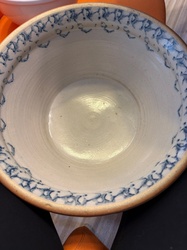
Submitted item photo
Submitted photo · June 19, 2026

User's notes

Original Crock from min 100 years

AI analysis below

AI appraisal

AI analysis & estimate

AI-Generated · Verify before acting

Everything below is generated by AI for informational purposes only. AI can make mistakes — the AI may misidentify items or misattribute them (artist, maker, brand, designer, origin, era). This is not an official valuation and should not be used for insurance, sale, tax, estate, legal, or lending purposes — or any decision requiring a certified appraisal. It is not an authoritative claim about any person, brand, or rights holder — do not share or rely on it as a factual statement about a third party. Always consult qualified professionals before making financial decisions.

Note

This analysis also relies on unverified notes provided by the user, which may be incomplete or inaccurate and could affect the result.

Read the full disclaimer

AI Identification

·Not independently authenticated·Verify before acting

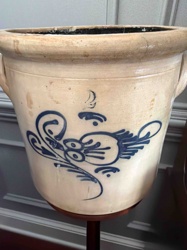
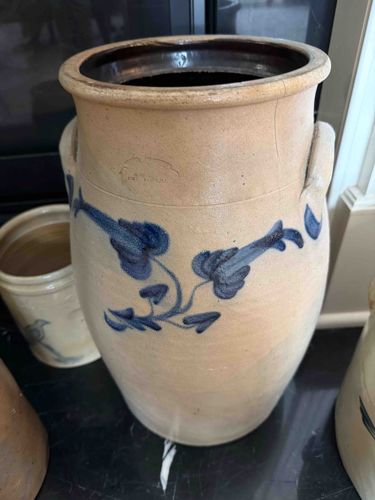
Antique Cobalt Decorated Salt-Glazed Stoneware Butter Crock

Antique American Stoneware

AI Estimated Value

·Not an official valuation·Verify before acting

$450 - $650

As of June 19, 2026

AI Item Analysis

·AI can make mistakes·Verify before acting
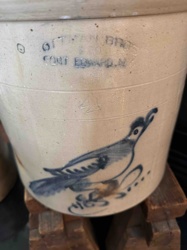
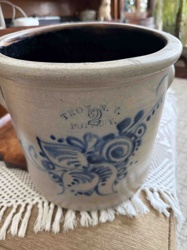
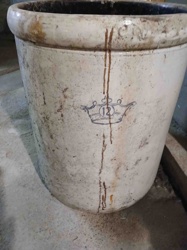
This is a significant example of American salt-glazed stoneware, likely dating from the mid-to-late 19th century (circa 1860-1890). The piece is a tall, cylindrical butter crock or preserve jar, expertly hand-thrown with a slightly ovoid profile tapering towards the base. The exterior features a classic salt-glazed finish, resulting in a characteristic 'orange peel' pitted texture and a light tan or buff coloration. Its most prominent decorative feature is the hand-painted cobalt blue foliate design, executed in thick, slip-trailed strokes that show a rich, deep blue hue with slight bleeding into the glaze, typical of high-quality period stoneware. The vessel includes two applied 'ear' handles (lug handles) on opposite sides, which are securely attached to the shoulder. There is a faint oval-shaped maker's mark or capacity stamp visible above the decoration, though it is partially obscured by the glaze. The interior is finished with a dark brown Albany-type slip glaze to ensure a non-porous surface for food storage. Condition-wise, the crock shows signs of age consistent with its 100+ year history, including several structural hairlines visible from the rim extending down the collar, and minor pitting or 'blowouts' from the firing process. There are visible surface abrasions and signs of use around the rim and handles, contributing to an authentic antique patina. The overall craftsmanship suggests a high level of skill from a professional regional pottery works.
AI Appraisal Report

·AI can make mistakes·Verify before acting
I have carefully reviewed the provided documentation and imagery for this American salt-glazed stoneware butter crock. The hand-thrown form, lug handle application, and slip-trailed cobalt foliate motif are stylistically consistent with 19th-century regional potteries, likely from the Mid-Atlantic or Northeastern United States. The Albany-type slip on the interior and the characteristic 'orange peel' texture confirm standard period manufacturing techniques. The faint maker's mark suggests a professional origin, though its partial obscurity limits direct attribution to a specific high-value potter like Norton or Remmey. Market demand for cobalt-decorated stoneware remains steady, though values are highly sensitive to condition. While the deep blue pigment is desirable, the presence of structural hairlines extending from the rim significantly impacts the valuation, as collectors prioritize 'ringing' pieces without integrity issues. Comparable examples with similar damage typically realize mid-range prices, whereas pristine examples could exceed $1,000. Potential 'blowouts' are noted as firing defects common to the era and do not detract as much as post-production damage. Limitations: This appraisal is based on digital images and descriptions. Without physical inspection, I cannot verify the resonance of the clay body or detect professional restoration (common on hairlines). Full authentication would require a 360-degree tactile examination, verification of the maker's stamp under high-resolution magnification, and provenance history to establish a chain of ownership. In-person testing would also ensure the glaze is not a modern reproduction with chemical aging.

Get your items appraised

Instant estimates of your treasures with AI-powered appraisals

Browse More Appraisals