AI estimate as of August 9, 2025 · verify with a professional before acting
AI-Generated · Verify before acting
Everything on this page is generated by AI for informational purposes only. AI can make mistakes — the AI may misidentify items or misattribute them (artist, maker, brand, designer, origin, era). This is not an official valuation and should not be used for insurance, sale, tax, estate, legal, or lending purposes — or any decision requiring a certified appraisal. It is not an authoritative claim about any person, brand, or rights holder — do not share or rely on it as a factual statement about a third party. Always consult qualified professionals before making financial decisions.
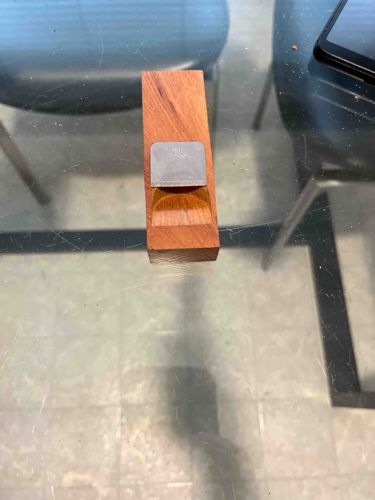
The item is a small, compact hand plane, often referred to as a Japanese block plane or 'kanna'. It features a solid, rectangular body crafted from what appears to be a dense, reddish-brown hardwood, possibly a type of fruitwood or tropical hardwood like Ipe or Padauk, given its warm tone and visible tight grain. The body exhibits a natural wood finish, showing some minor surface wear consistent with use but no significant damage or deep gouges. The top surface of the plane includes a rectangular metal blade, or 'iron', which is secured within a precisely cut mortise in the wooden body. The blade is greyish-silver in color, indicating it is made of steel, and it protrudes slightly from the bottom edge, forming the cutting edge. There is a visible, curved throat or mouth carved into the wood directly beneath the blade, designed to allow shavings to exit during use. A series of faint, possibly stamped or etched markings, though illegible from this image, are present on the top surface of the metal blade, which could be a manufacturer's mark, steel type, or an indication of origin. The overall construction suggests a traditional, minimalist design focused on functionality and precision, typical of Japanese woodworking tools. The wood shows a slight sheen, suggesting it might have been oiled or waxed. There are no obvious repairs, and the tool appears to be in good, usable condition with a natural patina developed from age and handling. This type of plane is often used for fine finishing work or chamfering.
AI Appraisal Report
Upon visual examination of the provided image, I assess this Japanese block plane, or 'kanna', to be in good, usable condition. The hardwood body exhibits minor surface wear consistent with age and use, without significant damage, which suggests a natural patina rather than neglect. The visible, tight grain and reddish-brown hue point to a dense, quality hardwood, possibly Ipe or Padauk, enhancing its durability and aesthetic appeal. The steel blade appears well-seated with a clean cutting edge, though its precise sharpness and metallurgical properties cannot be determined remotely.
Authenticity, based solely on this image, appears high for a traditional Japanese woodworking tool. The minimalist design, precise mortise, and typical throat carving all align with characteristic kanna construction. However, a definitive authentication of origin and maker requires in-person examination. Specifically, closer inspection and cleaning of the faint markings on the blade are crucial for identifying a potential maker or brand, which could significantly impact value. Also, direct assessment of the blade's steel quality (e.g., laminated vs. solid, type of steel) and the wooden body's stability (e.g., checks, warps) is necessary. Provenance documentation, if available, would further verify its history and authenticity.
In terms of market conditions, demand for well-maintained traditional Japanese woodworking tools remains steady among woodworkers, collectors, and enthusiasts who value precision and craftsmanship. While not exceptionally rare, a high-quality kanna from a reputable maker, or one with exceptional wood or blade material, fetches a premium. Factors significantly impacting value include the maker's reputation (if identifiable), the blade's quality, the type and condition of the wood, and overall functionality. Without clear maker's marks or detailed provenance, it's challenging to ascertain if this specific piece is from a renowned craftsman or a more common production.
My valuation accounts for its apparent good condition and typical traditional construction, but conservatively considers the limitations of visual-only appraisal.