AI estimate as of October 23, 2025 · verify with a professional before acting
AI-Generated · Verify before acting
Everything on this page is generated by AI for informational purposes only. AI can make mistakes — the AI may misidentify items or misattribute them (artist, maker, brand, designer, origin, era). This is not an official valuation and should not be used for insurance, sale, tax, estate, legal, or lending purposes — or any decision requiring a certified appraisal. It is not an authoritative claim about any person, brand, or rights holder — do not share or rely on it as a factual statement about a third party. Always consult qualified professionals before making financial decisions.
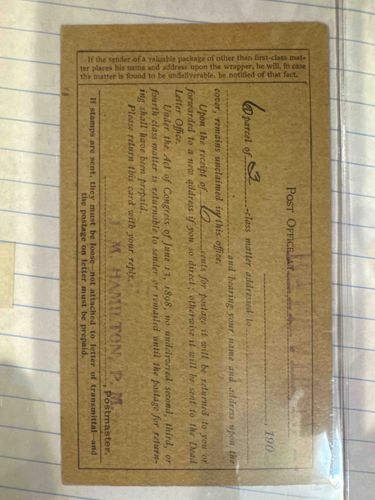
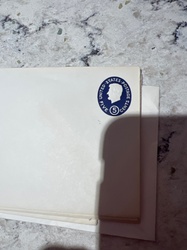
This item is an antique or vintage U.S. Postal Service notification card, which appears to be a standardized form sent by a Postmaster to inform a sender about an unclaimed 'parcel of' mail. The card is printed on sturdy, light brown or tan cardstock, characteristic of early 20th-century postal forms. The text is printed in black ink, primarily in a serif typeface, with some areas, like 'Parcel of' and the date '190__', including handwritten-style script or allowing for handwritten entries. Specific phrases such as 'POST OFFICE AT' and 'M. HAMILTON, P. M. Postmaster' are clearly visible, indicating it was issued from a specific post office under Postmaster M. Hamilton. The card explicitly references the 'Act of Congress of June 13, 1898,' dating its use to the period following that legislation, likely placing its estimated age in the early 1900s, possibly around 1900-1910, given the '190' with a blank for the last digit. It details policies regarding unclaimed second, third, or fourth-class mail, requiring postage prepayment for return or remailing. Notable features include instructions for sending stamps (loose, not attached) and a clause about valuable packages. The card's condition appears relatively well-preserved for its age, with minor wear consistent with handling and storage, though specific creases or tears are not highly discernible from the image. The paper exhibits a uniform aged patina, indicating no significant bleaching or water damage. Its construction is simple: a single piece of cardstock, without any folds or complex design. The clear and concise instructions, typical of government forms, underscore its utilitarian purpose. This piece offers insight into historical postal regulations and communication methods in the United States.
AI Appraisal Report
Upon visual examination of the U.S. Postal Service 'Parcel of' Notification Card, I assess its condition as very good for its age, showing minor toning and expected wear for an item from the early 20th century. The text is clear and legible, with no apparent tears or significant creases. Authenticity is strongly suggested by the standardized government form layout, specific references to the 'Act of Congress of June 13, 1898,' and the characteristic printing style of the era. However, full authentication without physical examination is limited; I cannot assess paper quality, watermarks, or printing nuances that might reveal a reproduction. An in-person inspection would allow for examination of paper fibers, ink composition, and any embossed details for definitive authentication.
In terms of market conditions, items like this fall under postal ephemera. While interesting historically, notification cards are generally not in high demand unless tied to a significant event, a rare Postmaster, or an unusual postal marking. Comparables in the market for similar early 20th-century U.S. postal forms, especially common notification types, typically range from $15 to $75. The card’s specific Postmaster, M. Hamilton, does not appear to be of significant historical note to drive up value. Demand is modest, primarily from specialized collectors of postal history or ephemera. Rarity is moderate; while not unique, these aren't found in abundance. The primary value drivers are its age, good condition, and the glimpse it offers into historical postal regulations. The blank date '190__' is less desirable than a fully dated, used example. Without further identifying marks or a unique Postmaster, its appeal remains primarily as a representative piece of early 20th-century postal communication.