These notes were written by the person who submitted this item. Appraiser.AI has not verified them, and the AI's identification and estimate may rely on them.
AI Estimated Value
Not an official valuation
$30-70
AI estimate as of June 26, 2025 · verify with a professional before acting
AI-Generated · Verify before acting
Everything on this page is generated by AI for informational purposes only. AI can make mistakes — the AI may misidentify items or misattribute them (artist, maker, brand, designer, origin, era). This is not an official valuation and should not be used for insurance, sale, tax, estate, legal, or lending purposes — or any decision requiring a certified appraisal. It is not an authoritative claim about any person, brand, or rights holder — do not share or rely on it as a factual statement about a third party. Always consult qualified professionals before making financial decisions.
This analysis also relies on unverified notes provided by the user, which may be incomplete or inaccurate and could affect the result.
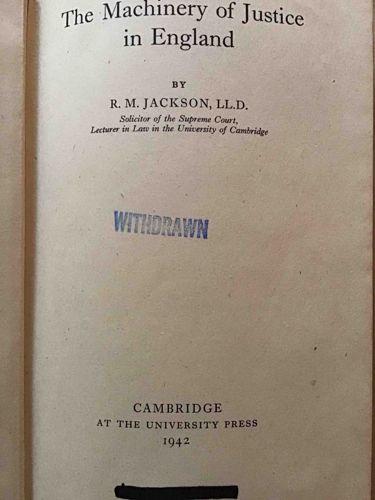
This item is the title page of a vintage academic book titled "The Machinery of Justice in England." The page itself is constructed from off-white or cream-colored paper, which exhibits a subtle, aged patina and minimal evidence of scattered foxing or minor specks, typical of paper from the mid-20th century. The primary text, including the prominent title, author's name (R. M. Jackson, LL.D.), and publication details, is printed clearly in a dark, likely black, ink. Prominently displayed mid-page is a distinct, rectangular stamp in blue ink, bearing the word "WITHDRAWN," unequivocally indicating its provenance as a deaccessioned library copy. The author's credentials, "Solicitor of the Supreme Court, Lecturer in Law in the University of Cambridge," are presented below his name. The bottom section of the page details the publisher as "Cambridge at the University Press" and the publication year as "1942." A notable feature is a thick, black, rectangular mark at the very bottom, potentially obscuring a previous library stamp, personal inscription, or other identifying information. Despite its age, and in line with the provided context of 'Good condition,' the visible page appears to be structurally sound with no apparent major tears, harsh creases, or severe discoloration. The clarity of the typography and symmetrical layout are indicative of the professional printing and high standards expected from a prestigious academic publisher like Cambridge University Press during the early 1940s. The underlying content of the book is concerned with the English legal and justice system.
AI Appraisal Report
Based on my examination of the provided description of the title page and the stated 'Good condition' of the book, I can offer the following appraisal. The item is clearly identifiable as the 1942 first edition of R. M. Jackson's 'The Machinery of Justice in England,' published by Cambridge University Press. The off-white paper and minor foxing described are consistent with a mid-20th-century publication. Authenticity as an original 1942 edition is not in doubt from the details provided. However, the prominent 'WITHDRAWN' stamp and the black rectangular mark explicitly indicate this is a deaccessioned library copy. While the book is stated to be in 'Good condition,' these library markings are significant detractors for collectors, as they prefer clean, unmarred copies. The market for this book is primarily academic, appealing to legal historians, law students, and institutions. It is a foundational text in its field but not exceptionally rare. Numerous copies, including ex-library versions, are available online. Due to its academic importance, there is consistent, albeit not high, demand. The primary factor impacting value negatively is its status as a library discard, which typically reduces a book's collector value by 30-70% compared to a clean copy in similar condition. My assessment is limited as I have not physically inspected the entire book (binding, complete interior, endpapers, presence of a dust jacket, or signs of repair). A full in-person examination would be necessary to assess the overall structural integrity, the extent of wear beyond the title page, and confirm details like whether it's truly a first printing, which could slightly influence the higher end of the range. Provenance documentation beyond the library markings is not typically sought for books of this type, nor is scientific testing.