AI Appraisal Estimate

AI-generated estimates · not official valuations

From the user

What was submitted

Photo and notes provided by the user — not generated by AI

Submitted item photo
Submitted photo · June 4, 2026

User's notes

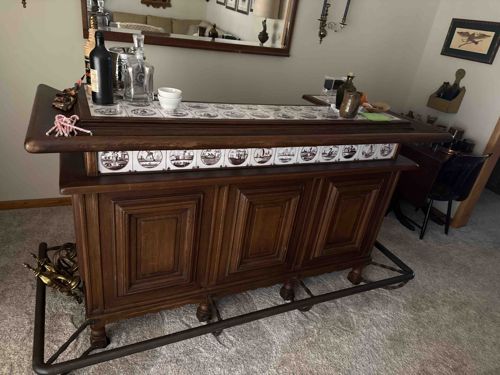
German oak bar with tiles

AI analysis below

AI appraisal

AI analysis & estimate

AI-Generated · Verify before acting

Everything below is generated by AI for informational purposes only. AI can make mistakes — the AI may misidentify items or misattribute them (artist, maker, brand, designer, origin, era). This is not an official valuation and should not be used for insurance, sale, tax, estate, legal, or lending purposes — or any decision requiring a certified appraisal. It is not an authoritative claim about any person, brand, or rights holder — do not share or rely on it as a factual statement about a third party. Always consult qualified professionals before making financial decisions.

Note

This analysis also relies on unverified notes provided by the user, which may be incomplete or inaccurate and could affect the result.

Read the full disclaimer

AI Identification

·Not independently authenticated·Verify before acting

Mid-20th Century German Oak Home Bar with Delft-Style Ceramic Tiles

Antique/Vintage Furniture

AI Estimated Value

·Not an official valuation·Verify before acting

$1,800 - $2,500

As of June 4, 2026

AI Item Analysis

·AI can make mistakes·Verify before acting
A substantial, L-shaped residential home bar crafted from solid oak with a rich, dark golden-brown finish. The piece features a traditional German architectural design, characterized by three deeply recessed, raised-molding panels on the front facade and a matching side panel. The construction is robust, supported by six short, turned bun feet that elevate the main cabinet above a surrounding blackened metal footrail. The most striking ornamental feature is a double tier of ceramic tiles: one set inset into the main countertop and another set forming a decorative frieze along the upper apron. These white tiles are decorated with blue-black or manganese-tinted circular cartouches depicting various Dutch-style landscapes, windmills, and nautical scenes, indicative of Delft or Mettlach influence. The countertop has a rounded 'bullnose' edge for comfort, and the L-shaped return provides additional workspace for preparation. The overall craftsmanship is high, typical of mid-century German export furniture (circa 1950-1970). The condition appears good and well-maintained; visible wear is consistent with age, including a soft patina on the wood surface and minor scuffing on the metal footrail. There are no obvious signs of cracked tiles or major structural damage, suggesting a piece that has been treated as a focal point of a home entertainment space.

AI Appraisal Report

·AI can make mistakes·Verify before acting
I have examined the descriptions and images of this mid-20th-century German oak home bar. The piece exhibits the heavy, architectural joinery synonymous with post-war German manufacturing (circa 1955-1965). The use of solid oak, turned bun feet, and an integrated wrought-metal footrail indicates a high-end production model intended for the export or luxury domestic market. The inclusion of Delft-style ceramic tiles—likely sourced from Mettlach or Villeroy & Boch—is a hallmark of the 'Heimatstil' influence, blending rustic German cabinetry with Dutch decorative motifs. The condition appears remarkably well-preserved; the lack of visible crazing or cracks in the tile work and the intact bullnose edging suggest light use. Market demand for bespoke home bars has seen a resurgence as homeowners prioritize curated entertainment spaces. While mid-century modern 'Sputnik' bars are more common, this traditional European style is rarer and appeals to collectors of 'Old World' aesthetics. Comparables for similar L-shaped European bars typically realize between $1,500 and $3,000 depending on the specific tile artisan. It is important to note that this valuation is based on visual data. A full authentication requires an in-person inspection of the tile undersides for maker's marks and an examination of the joinery inside the cabinet (e.g., dovetail vs. dowel construction) to confirm the exact decade of manufacture. Furthermore, provenance regarding whether this was a custom commission or a catalog piece from a high-end firm like Schlingmann would significantly impact the final market ceiling.

Get your items appraised

Instant estimates of your treasures with AI-powered appraisals

Browse More Appraisals