L'Homme dans la Ville by Jean Lambert-Rucki
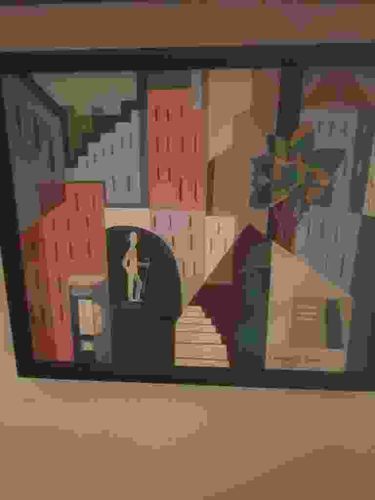
This artwork is a notable example of the Cubist and Art Deco synthesis popularized by the Polish-French artist Jean Lambert-Rucki (1888-1967). The piece, titled 'L'Homme dans la Ville' (Man in the City), features a stylized, geometric composition depicting a lone figure navigating a dense urban labyrinth. The palette is composed of muted earth tones, terracotta reds, ochre, and grays, applied in flat, planar sections that emphasize structural form over realistic perspective. The central figure is simplified into an elongated, almost sculptural silhouette, a hallmark of the artist’s work during the interwar period, approximately late 1920s to 1930s. Construction appears to be oil or gouache on a flat substrate, possibly panel or heavy paper, enclosed in a simple dark wooden frame that provides a stark modern contrast. The condition appears stable with minor surface dust and potential light fading consistent with age. The craftsmanship reflects the Section d'Or influence, prioritizing rhythmic geometry and architectural balance. Such works are quintessential of the Parisian School of Art Deco, bridging the gap between traditional painting and modern decorative architectural aesthetics.
AI-Generated Appraisal Disclaimer
Estimated Value
$15,000 - $25,000
Basic Information
Category
Fine Art - Paintings
Appraised On
February 11, 2026
Estimated Value
$15,000 - $25,000
Additional Details Provided By Owner
User Provided Information
Lambert Rucki. l'homme dans la ville
Item Description
This artwork is a notable example of the Cubist and Art Deco synthesis popularized by the Polish-French artist Jean Lambert-Rucki (1888-1967). The piece, titled 'L'Homme dans la Ville' (Man in the City), features a stylized, geometric composition depicting a lone figure navigating a dense urban labyrinth. The palette is composed of muted earth tones, terracotta reds, ochre, and grays, applied in flat, planar sections that emphasize structural form over realistic perspective. The central figure is simplified into an elongated, almost sculptural silhouette, a hallmark of the artist’s work during the interwar period, approximately late 1920s to 1930s. Construction appears to be oil or gouache on a flat substrate, possibly panel or heavy paper, enclosed in a simple dark wooden frame that provides a stark modern contrast. The condition appears stable with minor surface dust and potential light fading consistent with age. The craftsmanship reflects the Section d'Or influence, prioritizing rhythmic geometry and architectural balance. Such works are quintessential of the Parisian School of Art Deco, bridging the gap between traditional painting and modern decorative architectural aesthetics.

Related Tags
Get Your Items Appraised
Instant estimates of your treasures with AI-powered instant appraisals