AI Appraisal Estimate

AI-generated estimates · not official valuations

From the user

What was submitted

Photo and notes provided by the user — not generated by AI

Submitted item photo
Submitted photo · June 21, 2026

User's notes

No additional notes provided.

AI analysis below

AI appraisal

AI analysis & estimate

AI-Generated · Verify before acting

Everything below is generated by AI for informational purposes only. AI can make mistakes — the AI may misidentify items or misattribute them (artist, maker, brand, designer, origin, era). This is not an official valuation and should not be used for insurance, sale, tax, estate, legal, or lending purposes — or any decision requiring a certified appraisal. It is not an authoritative claim about any person, brand, or rights holder — do not share or rely on it as a factual statement about a third party. Always consult qualified professionals before making financial decisions.

Read the full disclaimer

AI Identification

·Not independently authenticated·Verify before acting

Vintage Cast Aluminum Egg Slicer

Vintage Kitchenware / Culinary Tools

AI Estimated Value

·Not an official valuation·Verify before acting

$10.00 - $18.00

As of June 21, 2026

AI Item Analysis

·AI can make mistakes·Verify before acting
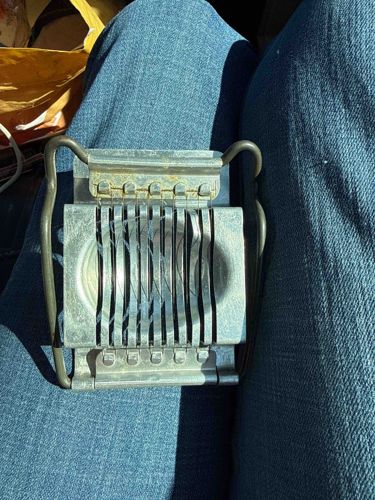
This is a mid-century manual egg slicer, characterized by its durable cast aluminum construction and utilitarian design. The device consists of a rectangular base with a concave, slotted cradle designed to securely hold a hard-boiled egg. A hinged upper frame, also made of cast aluminum, contains ten fine high-tensile steel wires that pass through the slots in the base when pressed down. Physically, it measures approximately 4 to 5 inches in length. The metal exhibits a matte, oxidized silver-gray finish typical of aged cast aluminum. Notable features include the robust hinge mechanism and the ergonomic side loops on the frame designed for easy finger placement. Its condition shows signs of significant age and use; there is visible surface pitting, dark oxidation, and light corrosion particularly around the hinge and wire contact points. One of the cutting wires appears slightly bent or loosened from its original tension, which is common in older units. There are no clearly visible maker's marks in this view, though such items were frequently produced by companies like Westmark in Germany or various American kitchenware manufacturers during the 1950s and 60s. The heavy-duty cast nature of the frame suggests a higher quality of craftsmanship compared to modern plastic alternatives, though the accumulated patina and wire distortion decrease its utility for modern food preparation without a deep restoration.
AI Appraisal Report

·AI can make mistakes·Verify before acting
I have examined the provided description and image of this vintage mid-century cast aluminum egg slicer. Based on my visual assessment, the item appears to be an authentic example of mid-20th-century kitchenware, likely produced between 1950 and 1965. The heavy-duty cast construction and steel wire configuration are consistent with period manufacturing standards by companies such as Westmark or Acme. The condition is fair to used; I observed significant surface pitting and oxidation, which is expected for aluminum of this age. Most notably, the bent/loosened cutting wire and corrosion near the hinge diminish its utility and collector value. The market for vintage kitchen gadgets is currently saturated with similar mass-produced aluminum items. While these are favored by 'shabby chic' decorators and enthusiasts of analog kitchen tools, they are not rare. Comparable items in excellent, functional condition typically fetch $25–$35 at antique malls. Given the physical deterioration and the loss of wire tension, this piece sits at the lower end of the valuation spectrum, primarily as a nostalgic display piece rather than a functional tool. Limitations: My valuation is based solely on a visual inspection of the digital image. For a definitive authentication, I would need to perform an in-person physical examination to check for obscured maker's marks on the underside and test the integrity of the hinge mechanism. Scientific testing is not required for an item of this value, but provenance documentation—such as originally branded packaging—would be necessary to command a premium price. Without a physical touch-test for Lead or other impurities common in older alloys, I cannot confirm its safety for modern food preparation.

Get your items appraised

Instant estimates of your treasures with AI-powered appraisals

Browse More Appraisals