AI estimate as of August 4, 2025 · verify with a professional before acting
AI-Generated · Verify before acting
Everything on this page is generated by AI for informational purposes only. AI can make mistakes — the AI may misidentify items or misattribute them (artist, maker, brand, designer, origin, era). This is not an official valuation and should not be used for insurance, sale, tax, estate, legal, or lending purposes — or any decision requiring a certified appraisal. It is not an authoritative claim about any person, brand, or rights holder — do not share or rely on it as a factual statement about a third party. Always consult qualified professionals before making financial decisions.
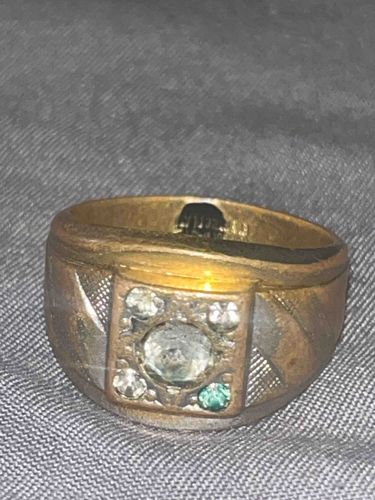
The item is a men's ring, likely a signet or statement ring given its broad band and prominent face. The ring appears to be constructed from a base metal, possibly brass or a gold-tone alloy, with a silver-tone or rhodium-plated top surface on the shoulders leading to the bezel. The band itself is wide and somewhat thick, suggesting durability. The design features a central rectangular bezel, which is set with multiple stones. The main central stone is circular and appears to be a clear or very light blue/green artificial gem, possibly glass or cubic zirconia, showing significant dirt or scratching on its surface. Surrounding this central stone are four smaller, clear, circular stones, one at each corner of the rectangular setting. Directly below the central stone, towards the bottom right corner of the bezel, there is a single small, round, opaque green stone, likely an imitation emerald or simply a dyed glass bead, which is distinctly different from the other clear stones. Both the clear and green stones exhibit a dullness, suggesting they are not natural high-quality gemstones, or are heavily abraded/dirty. The shoulders of the ring, where the band widens towards the bezel, feature a textured, possibly engraved or cast, geometric pattern, which appears to be a series of diagonal lines or ridges. The overall condition shows considerable wear, including discoloration and tarnishing on the gold-tone metal, which could indicate a plated finish that has worn off in areas. The silver-tone top surface is also dull and scratched. There is a visible black mark/dent on the inside of the band, possibly from a previous resizing or damage. Inside the band, there appears to be a partially visible mark, possibly a manufacturer's stamp or purity mark, but it is illegible from the image. Given the style and apparent materials, this ring likely dates from the mid-20th century to late 20th century, possibly as costume jewelry or a more affordable piece. The craftsmanship is utilitarian rather than fine, as evidenced by the setting of the stones and the general finish.
AI Appraisal Report
Upon visual examination of the provided image, this men's multistone ring appears to be costume jewelry. The base metal shows significant wear, tarnishing, and discoloration consistent with a plated finish rather than solid gold. The silver-tone accents also exhibit dullness and scratching. The stones—a central clear circular gem, surrounding smaller clear stones, and a single opaque green stone—lack the brilliance and clarity of natural gemstones. They appear to be glass or cubic zirconia, with the central clear stone showing considerable surface abrasion or dirt, and the green stone an obvious imitation. The overall craftsmanship is utilitarian, with stones likely set in an unsophisticated manner.
Given the materials, condition, and apparent construction, this piece has limited intrinsic value. Its value is primarily decorative, or for parts/scrap. There is no indication of precious metals or genuine gemstones. The market for such costume jewelry, particularly in this condition, is low. Comparables would include vintage costume rings from the mid to late 20th century found at estate sales or online, typically retailing for under $50. Demand is minimal, and rarity is not a factor as similar items were mass-produced. Factors significantly impacting value include the non-precious materials, poor condition, and lack of fine craftsmanship.
It is important to note the limitations of verifying authenticity from images alone. A definitive authentication and appraisal would require an in-person examination to assess the metal composition (e.g., acid testing, XRF analysis), stone type (e.g., refractometer, spectroscopy), and construction quality. Provenance documentation would also be valuable but is unlikely for such an item.