Artist-Signed Moroccan Ceramic Darbuka (Goblet Drum)
Musical Instruments / Percussion / Ethnographic Art

Artist-Signed Moroccan Ceramic Darbuka (Goblet Drum)

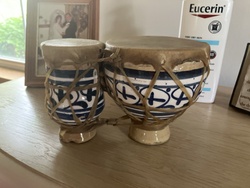
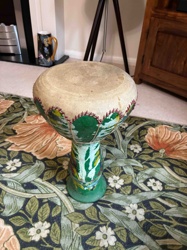
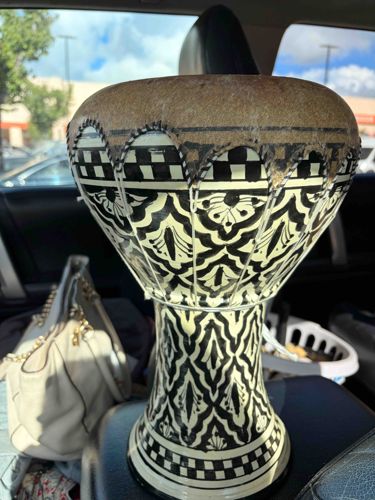
This is a 14-inch Moroccan darbuka, a goblet-shaped percussion instrument hand-crafted from kiln-fired clay. The exterior is coated in a white glaze and intricately hand-painted with traditional North African geometric and floral motifs in a striking black pigment. The design features a checkerboard pattern near the rim and base, with complex arabesque and tear-drop patterns covering the body and pedestal. The drumhead is made of natural animal hide, likely goat or fish skin, which is characteristic of traditional ceramic drums. This skin is secured to the clay body using a criss-cross lacing system made of thin cordage or gut, which allows for mechanical tensioning. Physical inspection suggests a high level of craftsmanship in the symmetry of the clay body and the precision of the hand-painted linework. The condition appears fair to good; while the ceramic body seems intact, the skin head shows significant signs of age and dehydration, appearing frayed and brittle along the edges where it meets the lacing. The patina on the hide suggests the piece has significant age, likely mid-to-late 20th century. While the artist's signature is noted in the context, it is not clearly visible in this specific view, though such marks are typically found on the interior rim or the underside of the base. This type of drum is highly valued for its warm, resonant bass tones compared to modern aluminum versions.
Estimated Value

$150 - $250

Basic Information

Category

Musical Instruments / Percussion / Ethnographic Art

Appraised On

January 10, 2026

Estimated Value

$150 - $250

Additional Details Provided By Owner

User Provided Information

14” Artist signed clay darbukq drum

Item Description

This is a 14-inch Moroccan darbuka, a goblet-shaped percussion instrument hand-crafted from kiln-fired clay. The exterior is coated in a white glaze and intricately hand-painted with traditional North African geometric and floral motifs in a striking black pigment. The design features a checkerboard pattern near the rim and base, with complex arabesque and tear-drop patterns covering the body and pedestal. The drumhead is made of natural animal hide, likely goat or fish skin, which is characteristic of traditional ceramic drums. This skin is secured to the clay body using a criss-cross lacing system made of thin cordage or gut, which allows for mechanical tensioning. Physical inspection suggests a high level of craftsmanship in the symmetry of the clay body and the precision of the hand-painted linework. The condition appears fair to good; while the ceramic body seems intact, the skin head shows significant signs of age and dehydration, appearing frayed and brittle along the edges where it meets the lacing. The patina on the hide suggests the piece has significant age, likely mid-to-late 20th century. While the artist's signature is noted in the context, it is not clearly visible in this specific view, though such marks are typically found on the interior rim or the underside of the base. This type of drum is highly valued for its warm, resonant bass tones compared to modern aluminum versions.
Get Your Items Appraised

Instant estimates of your treasures with AI-powered instant appraisals

Browse More Appraisals