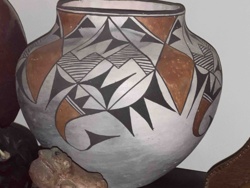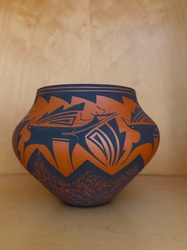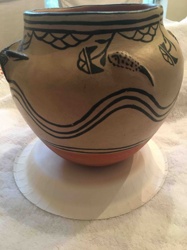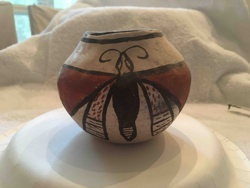
Pueblo Polychrome Shallow Bowl
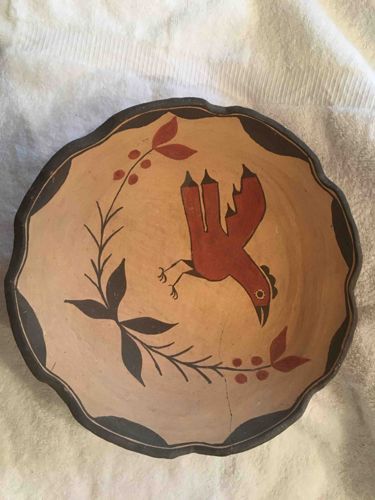
This is a shallow earthenware bowl, likely of Native American Pueblo origin, featuring a distinct scalloped or pie-crust rim. The piece is constructed using traditional coil techniques and finished with a buff or cream-colored slip. The interior decoration consists of a central avian figure rendered in red ochre and black mineral paint, surrounded by stylized floral or wheat-like sprigs with red berries. The avian figure is characteristic of the 'Thunderbird' or 'Roadrunner' motifs seen in mid-20th-century Southwest pottery. The scalloped rim is highlighted with a dark black or deep brown band of paint. In terms of condition, there is a prominent vertical hairline crack running from the six o'clock position upward through the center of the bowl, along with visible surface abrasions and minor paint loss consistent with age and handling. The matte finish and slight irregularities in the hand-painted lines suggest a handcrafted piece from the early-to-mid 20th century. No maker's mark is visible in this view, though it likely originated from a New Mexico pueblo such as Cochiti or Tesuque.
AI-Generated Appraisal Disclaimer
Estimated Value
$450–$700
Basic Information
Category
Native American Art & Ceramics
Appraised On
March 21, 2026
Estimated Value
$450–$700
Item Description
This is a shallow earthenware bowl, likely of Native American Pueblo origin, featuring a distinct scalloped or pie-crust rim. The piece is constructed using traditional coil techniques and finished with a buff or cream-colored slip. The interior decoration consists of a central avian figure rendered in red ochre and black mineral paint, surrounded by stylized floral or wheat-like sprigs with red berries. The avian figure is characteristic of the 'Thunderbird' or 'Roadrunner' motifs seen in mid-20th-century Southwest pottery. The scalloped rim is highlighted with a dark black or deep brown band of paint. In terms of condition, there is a prominent vertical hairline crack running from the six o'clock position upward through the center of the bowl, along with visible surface abrasions and minor paint loss consistent with age and handling. The matte finish and slight irregularities in the hand-painted lines suggest a handcrafted piece from the early-to-mid 20th century. No maker's mark is visible in this view, though it likely originated from a New Mexico pueblo such as Cochiti or Tesuque.
Get Your Items Appraised
Instant estimates of your treasures with AI-powered instant appraisals