Muscovite Mica Specimen
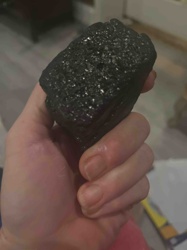
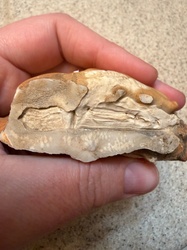
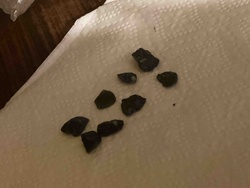
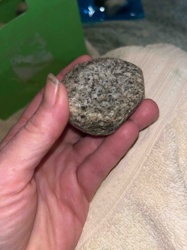
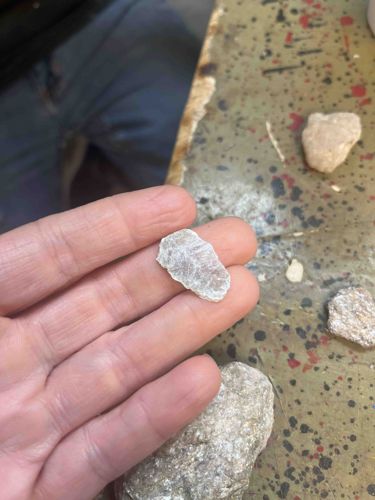
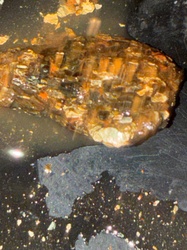
This item is a raw mineral specimen of Muscovite Mica, a common phyllosilicate mineral. Physically, the specimen is exhibited as a thin, translucent to pearly-white 'book' or flake, approximately 1 to 1.5 centimeters in length. It displays the classic monoclinic crystal system characteristic of the mica group, specifically its perfect basal cleavage, which allows the mineral to be split into exceptionally thin, flexible, and elastic sheets. The color is a pale silvery-white with a distinct vitreous to pearly luster that catches the light brilliantly. The edges are uneven and naturally fractured, showing the delicate, layered construction of the mineral. Notable features include the transparency of the flake when held against the skin and the visible internal striations. There are no signs of artificial processing, signifying it is a natural geological sample. The condition appears stable for a mineral of this type, though the edges are prone to minor flaking (shaling) due to its low Mohs hardness (typically 2–2.5). There are no maker's marks or signatures as this is a natural earth-born object. This type of mineral has been utilized for centuries in industrial applications such as electrical insulation and as a window material in high-temperature furnaces during the 19th century.
AI-Generated Appraisal Disclaimer
Estimated Value
$5 - $15
Basic Information
Category
Geological Specimens / Minerals
Appraised On
March 24, 2026
Estimated Value
$5 - $15
Item Description
This item is a raw mineral specimen of Muscovite Mica, a common phyllosilicate mineral. Physically, the specimen is exhibited as a thin, translucent to pearly-white 'book' or flake, approximately 1 to 1.5 centimeters in length. It displays the classic monoclinic crystal system characteristic of the mica group, specifically its perfect basal cleavage, which allows the mineral to be split into exceptionally thin, flexible, and elastic sheets. The color is a pale silvery-white with a distinct vitreous to pearly luster that catches the light brilliantly. The edges are uneven and naturally fractured, showing the delicate, layered construction of the mineral. Notable features include the transparency of the flake when held against the skin and the visible internal striations. There are no signs of artificial processing, signifying it is a natural geological sample. The condition appears stable for a mineral of this type, though the edges are prone to minor flaking (shaling) due to its low Mohs hardness (typically 2–2.5). There are no maker's marks or signatures as this is a natural earth-born object. This type of mineral has been utilized for centuries in industrial applications such as electrical insulation and as a window material in high-temperature furnaces during the 19th century.
Related Tags
Get Your Items Appraised
Instant estimates of your treasures with AI-powered instant appraisals