AI Appraisal Estimate

AI-generated estimates · not official valuations

From the user

What was submitted

Photo and notes provided by the user — not generated by AI

Submitted item photo
Submitted photo · June 17, 2026

User's notes

Category: Other amuleto de salud comprado en mercado de los brujos la paz Bolivia viaje 1985. artesanía contemporánea

AI analysis below

AI appraisal

AI analysis & estimate

AI-Generated · Verify before acting

Everything below is generated by AI for informational purposes only. AI can make mistakes — the AI may misidentify items or misattribute them (artist, maker, brand, designer, origin, era). This is not an official valuation and should not be used for insurance, sale, tax, estate, legal, or lending purposes — or any decision requiring a certified appraisal. It is not an authoritative claim about any person, brand, or rights holder — do not share or rely on it as a factual statement about a third party. Always consult qualified professionals before making financial decisions.

Note

This analysis also relies on unverified notes provided by the user, which may be incomplete or inaccurate and could affect the result.

Read the full disclaimer

AI Identification

·Not independently authenticated·Verify before acting

Bolivian Carved Stone Turtle Amulet (Health Talisman)

Artisan Folk Art / Spiritual Amulets

AI Estimated Value

·Not an official valuation·Verify before acting

$45.00-$65.00

As of June 17, 2026

AI Item Analysis

·AI can make mistakes·Verify before acting
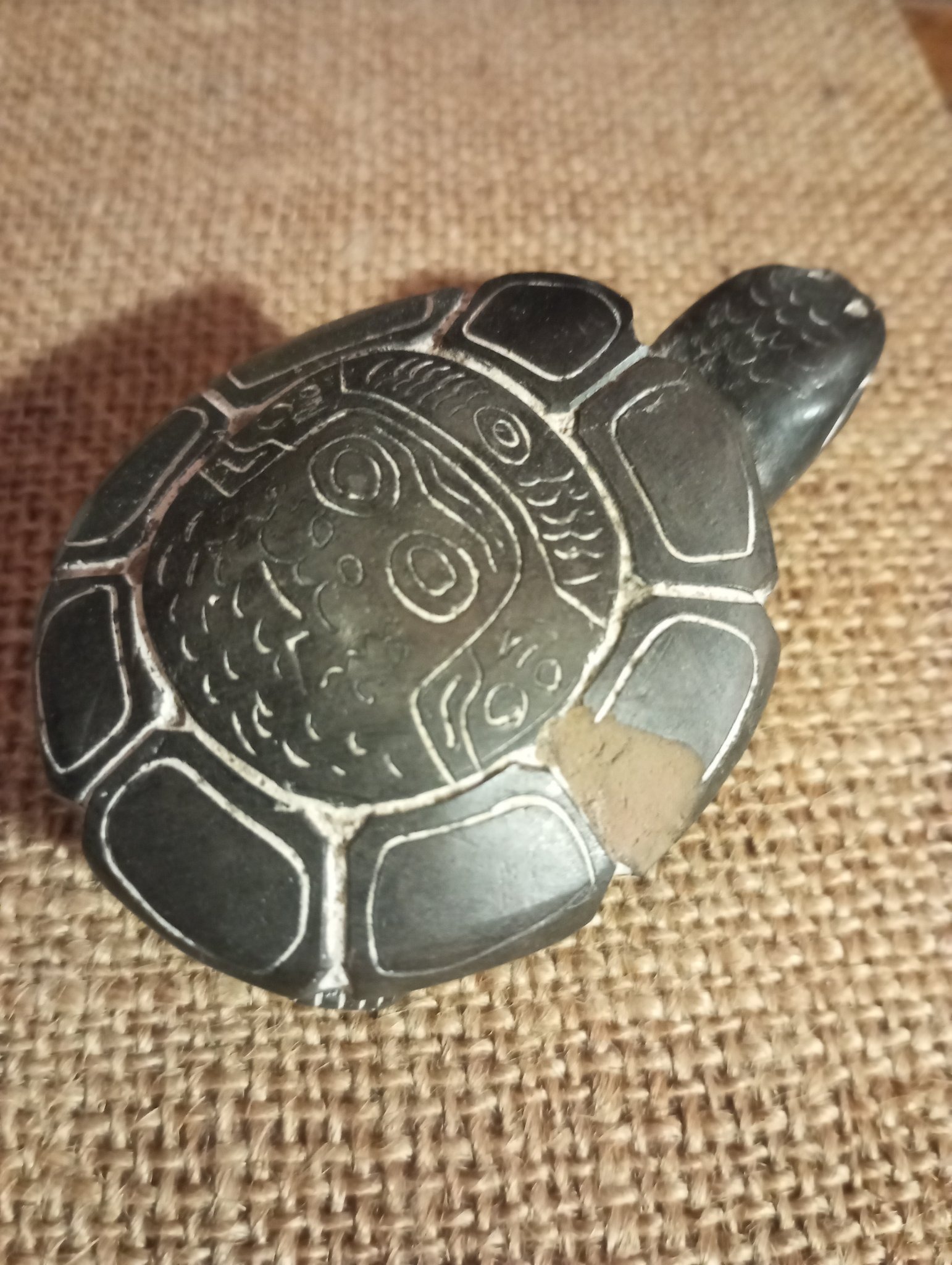
This item is a hand-carved stone amulet in the shape of a turtle, purchased in 1985 at the Witches' Market (Mercado de las Brujas) in La Paz, Bolivia. The figurine is crafted from a dark, dense, possibly basaltic or soapstone-like material with a matte black finish. The turtle's carapace (shell) is incised with traditional Andean folk-art motifs, featuring a central circular medallion depicting a stylized face with large concentric eyes, surrounded by scale-like patterns and geometric borders. The incisions are highlighted with a white powdery substance, a common technique in contemporary Bolivian artisan crafts to make carvings stand out against dark stone. The turtle's head and flippers are minimally rendered with textured scales. The piece measures approximately 3 to 4 inches in length. Regarding condition, there is a prominent chip or loss of material on the right-hand side of the shell, revealing a lighter, brownish interior stone or clay-like substrate. This damage suggests the item may be made of a compressed composite or a softer local stone. The overall surface shows light patina consistent with its mid-1980s origin, with some fading to the white inlay. This type of object is traditionally sold as a protective charm or ‘amuleto de salud’ (health amulet) within Aymara and Quechua spiritual practices.
AI Appraisal Report

·AI can make mistakes·Verify before acting
I have carefully examined the provided documentation and imagery for this Bolivian carved stone turtle amulet, acquired in 1985 at La Paz's Witches' Market. The piece is a classic example of contemporary Andean folk art designed for the spiritual tourist trade and local ritual use. Based on my visual inspection, the item is authentic to its stated provenance as a mid-1980s 'amuleto de salud.' The incised geometric patterns and the iconic central face reflect traditional Aymara aesthetics. However, the prominent chip on the right side of the carapace is a significant condition detraction; it reveals a lighter substrate, suggesting the material is likely a soft, local soapstone or a composite rather than high-density basalt. Market demand for these items remains steady but modest, as they were produced in significant quantities for the artisan markets of Bolivia. Comparables for similar vintage amulets typically range between $30 and $85 depending on size and condition. The damage to the shell significantly limits its value to the lower end of the spectrum, as collectors of spiritual folk art generally look for pristine carvings. Factors such as the 1980s patina and the original white-clay inlay provide authentic character, though the inlay shows expected fading. Please note that while the visual characteristics align with 1980s artisan production, a definitive material analysis would require a physical hardness test or spectrographic analysis to confirm if the substrate is natural stone or a molded resin-stone composite. Furthermore, while the purchase date is noted, original receipts from the Mercado de las Brujas would strengthen the provenance record.

Get your items appraised

Instant estimates of your treasures with AI-powered appraisals

Browse More Appraisals