AI estimate as of October 23, 2025 · verify with a professional before acting
AI-Generated · Verify before acting
Everything on this page is generated by AI for informational purposes only. AI can make mistakes — the AI may misidentify items or misattribute them (artist, maker, brand, designer, origin, era). This is not an official valuation and should not be used for insurance, sale, tax, estate, legal, or lending purposes — or any decision requiring a certified appraisal. It is not an authoritative claim about any person, brand, or rights holder — do not share or rely on it as a factual statement about a third party. Always consult qualified professionals before making financial decisions.
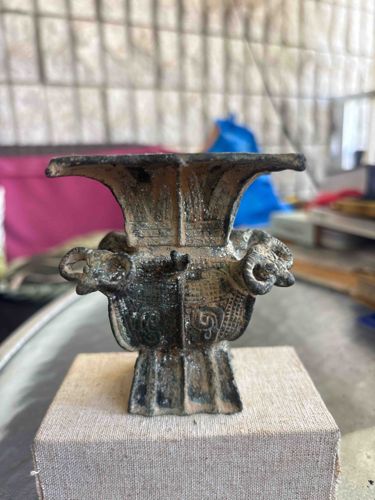
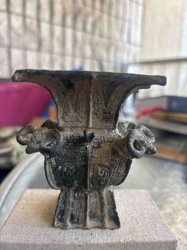
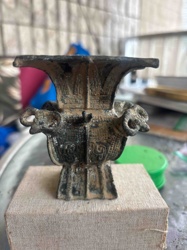
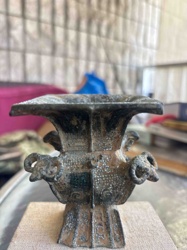
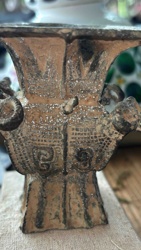
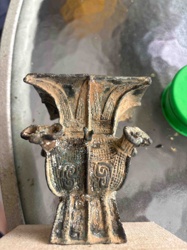
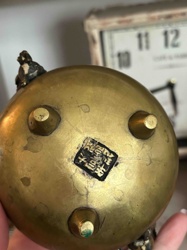
This item is an ancient Chinese bronze vessel, appearing to be a miniature or funerary urn (mingqi) version of a 'Gu' — a type of ritual wine vessel. It stands on a flared, rectangular base and tapers upwards to a broad, flaring rim, creating a trumpet-shaped mouth. The material is patinated bronze, exhibiting a mottled dark greenish-brown and black coloration, consistent with significant age and exposure, suggesting a natural oxidation process. The surface is textured and somewhat uneven, indicative of ancient casting techniques. Notable features include four zoomorphic ram's heads protruding from the vessel's mid-section, two clearly visible in the image, adding to its ritualistic or symbolic character. These ram heads integrate seamlessly into the vessel's design, positioned at the corners of the square body. The body of the vessel is adorned with intricate relief decorations, although specific motifs are difficult to decipher definitively from the provided image due to the heavy patination and resolution, they appear to be stylized geometric or possibly mythological patterns. The craftsmanship, despite the wear, suggests a detailed and deliberate casting process. There are visible signs of erosion and pitting on the bronze surface, typical of artifacts unearthed after prolonged burial. The edges of the rim and base show some irregularity, further supporting its antiquity and handmade origin. No specific maker's marks or signatures are discernible. Based on the style and typical forms, this piece likely dates to an early dynastic period of China, potentially Shang or Zhou dynasty, or a later reproduction aiming to emulate these ancient styles. The overall condition, while showing substantial age and wear, appears stable, without overt signs of recent damage or repair that would devalue it significantly, assuming the patina is natural and undisturbed. The item's petite size suggests it might have been an effigy or a smaller, symbolic offering rather than a full-sized ritual vessel.
AI Appraisal Report
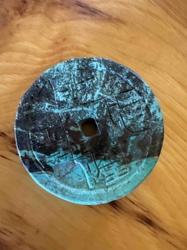
Upon visual examination of the provided image, this Ancient Chinese Bronze Gu-style Vessel with Ram Head Motifs displays characteristics consistent with significant age. The mottled dark greenish-brown and black patination, surface texture, and visible erosion and pitting are indicative of ancient bronze artifacts and prolonged burial. The craftsmanship, though obscured by patination and image resolution, suggests a detailed casting process for the intricate relief decorations and seamlessly integrated ram's heads. The vessel’s form, while emulating a 'Gu' type, appears to be a smaller, perhaps funerary ('mingqi') version, which was common. \n\nWithout physical examination, definitive authenticity as an ancient Shang or Zhou dynasty piece is challenging. There are numerous later reproductions and archaistic pieces. The current market for authentic early Chinese bronzes is strong, with significant demand for pieces with established provenance. However, given the potential for it to be a later artistic emulation or reproduction, and the reliance solely on images, its value is significantly impacted. Reproductions, even high-quality ones, fetch a fraction of what an authenticated ancient piece would. Factors like the unrefined edges and general wear lend credence to its antiquity or at least to a convincing older production. \n\nThe rarity of true ancient 'Gu' vessels of this specific ram-head design is high, but the rarity of this specific item depends entirely on its authenticity. Demand for well-preserved, authentic ancient Chinese bronzes is very high among collectors. For this particular piece, I would estimate a value in the range of $600-1,200, assuming it is an antique and not a modern replica, but likely not a top-tier ritual vessel from the earliest dynasties without further proof. \n\nLimitations in verifying authenticity from images alone are considerable. A conclusive appraisal would necessitate an in-person examination to assess the bronze alloy, casting methods, and tool marks. Scientific testing, such as XRF analysis and thermoluminescence dating of any core material (if applicable), would be essential for definitive dating. Furthermore, provenance documentation detailing its history of ownership and acquisition would significantly enhance its value and reduce authentication risks.