AI estimate as of October 7, 2025 · verify with a professional before acting
AI-Generated · Verify before acting
Everything on this page is generated by AI for informational purposes only. AI can make mistakes — the AI may misidentify items or misattribute them (artist, maker, brand, designer, origin, era). This is not an official valuation and should not be used for insurance, sale, tax, estate, legal, or lending purposes — or any decision requiring a certified appraisal. It is not an authoritative claim about any person, brand, or rights holder — do not share or rely on it as a factual statement about a third party. Always consult qualified professionals before making financial decisions.
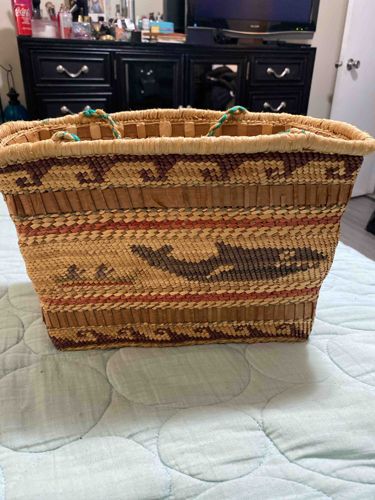
This is a rectangular-shaped, hand-woven basket, likely of Indigenous origin, showcasing intricate patterns and animal motifs. The primary material appears to be natural fibers, possibly splint wood or bark reeds, exhibiting natural light tan to medium brown coloration. The weaving technique visible is a combination of plain weave and possibly imbrication or false embroidery for the decorative elements. The basket features horizontal bands of geometric designs in darker browns, reds, and possibly black or very dark blue, suggesting dye work. A prominent central band depicts stylized animal figures, possibly fish or other aquatic creatures, in a dark brown or black shade, against a lighter background. Above and below this central band are additional geometric patterns. The rim of the basket is finished with a tightly woven band, giving it a sturdy and defined edge. Two small loops of what appears to be green cord or string are visible at the top edge, suggesting it might have had handles at some point or these are remnants of a carrying mechanism. The general condition appears to be good for an item of this type, with a visible patina consistent with age and use. There are no obvious signs of major breaks or repairs, though some minor fraying or wear might be present upon closer inspection, especially given the natural materials. The craftsmanship indicates a skilled artisan, typical of traditional Indigenous basketry, which often tells stories or represents cultural elements through its designs. Its style points to an estimated age of mid to late 20th century or possibly earlier, depending on the specific tribal attribution. The natural variations in fiber color and texture add to its unique character and authenticity.
AI Appraisal Report
Based on my visual examination of the provided image, this Indigenous woven basket presents as a well-crafted piece of cultural artifact. The rectangular shape, natural fiber materials (likely splint wood or bark reeds), and intricate weaving techniques, including what appears to be plain weave and decorative imbrication/false embroidery, are consistent with traditional Indigenous basketry. The natural light tan to medium brown coloration, coupled with applied darker browns, reds, and possibly black dyes for geometric and stylized animal (aquatic creatures) motifs, suggests a thoughtful design and skilled execution. The condition appears to be good, with a visible patina that is expected of an item with age and use, without obvious signs of major breaks or extensive repairs. The finishing of the rim and the presence of green cord loops, possibly remnants of a carrying mechanism, add to its historical character.
Authenticity, while visually compelling, cannot be definitively verified from images alone. A physical in-person examination would be crucial to assess fiber types, dye composition, and weaving tension more accurately. Provenance documentation, including tribal attribution (e.g., Plateau, Northwest Coast, California Pomo), would significantly enhance its value and confirm its cultural origin. Scientific testing could verify age and material origins. Market conditions for Indigenous basketry are steady for authentic, well-preserved examples with documented provenance. Comparables for similar mid to late 20th-century decorative baskets, particularly those with distinct animal motifs, typically range from $300 to $700, with rare or exceptionally important pieces fetching higher sums. Demand exists among collectors of Native American art and cultural artifacts. This basket's aesthetic appeal, good condition, and evident craftsmanship position it well within this market segment, even without full authentication. The primary factors impacting value at present are its visual condition, aesthetic complexity, and assumed age. Without definitive tribal attribution or provenance, the value remains conservative.