AI Appraisal Estimate

AI-generated estimates · not official valuations

From the user

What was submitted

Photo and notes provided by the user — not generated by AI

Submitted item photo
Submitted photo · June 6, 2026

User's notes

No additional notes provided.

AI analysis below

AI appraisal

AI analysis & estimate

AI-Generated · Verify before acting

Everything below is generated by AI for informational purposes only. AI can make mistakes — the AI may misidentify items or misattribute them (artist, maker, brand, designer, origin, era). This is not an official valuation and should not be used for insurance, sale, tax, estate, legal, or lending purposes — or any decision requiring a certified appraisal. It is not an authoritative claim about any person, brand, or rights holder — do not share or rely on it as a factual statement about a third party. Always consult qualified professionals before making financial decisions.

Read the full disclaimer

AI Identification

·Not independently authenticated·Verify before acting

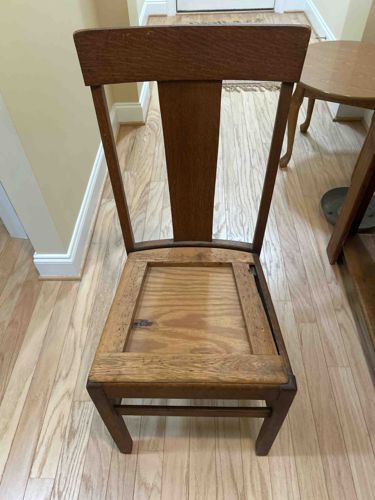
Antique Mission Style Quarter-Sawn Oak Dining Chair

Antique Furniture

AI Estimated Value

·Not an official valuation·Verify before acting

$150 - $250

As of June 6, 2026

AI Item Analysis

·AI can make mistakes·Verify before acting
An antique dining chair executed in the Mission or Arts and Crafts style, likely dating from the early 20th century (c. 1900-1920). The piece is constructed primarily of quarter-sawn white oak, showcasing characteristic heavy medullary ray flecking and a prominent grain pattern. The design features a tall, slightly raked back with a wide, tapered central splat and straight stiles terminating in a flat, rectangular top rail. The lower section consists of square-cut legs reinforced by simple box stretchers for structural stability. A notable condition issue is that the seat is currently missing its original upholstery or slip-seat insert, revealing the interior wooden frame and a flat plywood or solid wood support board underneath, which may be a later structural addition. The wood finish displays a medium-to-dark amber patina with visible wear, including scuffing on the top rail, finish loss on the seat rail edges, and minor nicks consistent with aged utility furniture. There are no immediate visible maker's marks or signatures in the provided image, though the robust mortise and tenon joinery suggests a high standard of early mass-production craftsmanship typical of manufacturers like Stickley or Limbert, though unauthenticated.
AI Appraisal Report

·AI can make mistakes·Verify before acting
I have conducted a visual examination of the Mission Style Quarter-Sawn Oak Dining Chair. The piece exhibits the standard hallmarks of the Arts and Crafts movement (c. 1900-1920), most notably the use of quarter-sawn white oak with visible medullary rays. The mortise and tenon joinery indicates a period of construction consistent with early 20th-century American manufacturing. However, the condition significantly impacts its current marketability. The absence of the original slip-seat or upholstery, combined with the presence of a likely non-original plywood support, relegates this to a 'project piece' status. While the wood retains a pleasing amber patina, the scuffing and finish loss on the rails suggest heavy use and a need for professional conservation. In the current market, unbranded Mission furniture faces stiff competition from modern reproductions and higher-end authenticated pieces. While the silhouette is reminiscent of 'Stickley' or 'Limbert' designs, the lack of a shop mark or paper label prevents me from assigning a premium 'branded' valuation. Comparables for single, unsigned chairs in this condition typically hammer at mid-range auctions between $150 and $250. A full set of six would command a higher per-item price due to rarity in sets. Final authentication remains provisional. A physical inspection is required to check for faint heat-stamps or remnants of paper labels on the inner seat rails. Furthermore, examining the underside of the wood for specific tool marks would help differentiate between a workshop piece and a generic factory production. Without provenance documentation or a confirmed maker’s mark, this item is valued as a functional period piece rather than a collector-grade investment.

Get your items appraised

Instant estimates of your treasures with AI-powered appraisals

Browse More Appraisals