AI Appraisal Estimate

AI-generated estimates · not official valuations

From the user

What was submitted

Photo and notes provided by the user — not generated by AI

Submitted item photo
Submitted photo · May 28, 2026

User's notes

No additional notes provided.

AI analysis below

AI appraisal

AI analysis & estimate

AI-Generated · Verify before acting

Everything below is generated by AI for informational purposes only. AI can make mistakes — the AI may misidentify items or misattribute them (artist, maker, brand, designer, origin, era). This is not an official valuation and should not be used for insurance, sale, tax, estate, legal, or lending purposes — or any decision requiring a certified appraisal. It is not an authoritative claim about any person, brand, or rights holder — do not share or rely on it as a factual statement about a third party. Always consult qualified professionals before making financial decisions.

Read the full disclaimer

AI Identification

·Not independently authenticated·Verify before acting

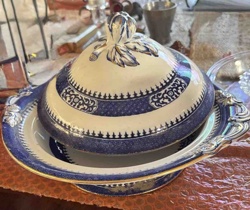
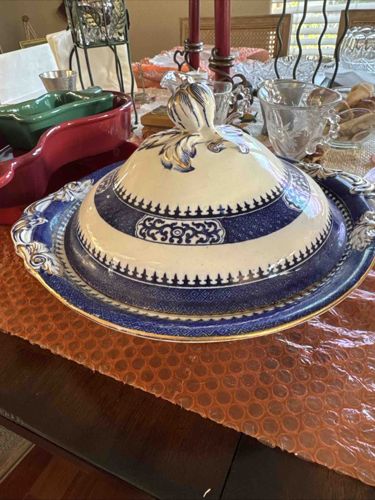
Victorian Era Flow Blue Covered Tureen or Vegetable Dish

Antique Ceramics and Pottery

AI Estimated Value

·Not an official valuation·Verify before acting

$250 - $450

As of May 28, 2026

AI Item Analysis

·AI can make mistakes·Verify before acting
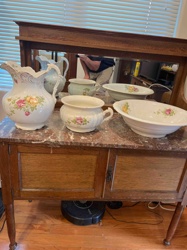
This is a substantial covered ceramic serving dish, likely a tureen or a large vegetable dish, featuring an ornate Flow Blue transferware design with gilded accents. The piece is constructed from high-quality earthenware or ironstone, common in late 19th-century English pottery. Its primary aesthetic is defined by the deep cobalt blue patterns that bleed slightly into the white glaze, a characteristic known as 'Flow Blue.' The centerpiece of the lid is an elaborate finial sculpted in a foliate or artichoke shape, highlighted with gold leaf. The body and lid are decorated with concentric bands of geometric fretwork, scalloped borders, and floral scrollwork. The rim of the base platter exhibits molded relief patterns with rococo-style scrolls. Condition-wise, the piece shows minor rubbing on the gold gilding along the edges and finial, which is typical for its estimated age (circa 1880-1900). There appears to be light crazing in the glaze and some minor surface wear, but no visible structural cracks or major chips are apparent from the primary angle. The craftsmanship suggests a reputable manufacturer such as Johnson Brothers, Grindley, or Wedgwood, though a definitive maker's mark would be located on the underside. This item is a classic example of Victorian-era tableware, blending functional utility with opulent decoration.
AI Appraisal Report

·AI can make mistakes·Verify before acting
Based on my visual examination of this Victorian-era Flow Blue covered vegetable dish, I have identified it as a high-quality example of Late 19th-century English ironstone. The deep cobalt saturation and characteristic 'flow' are consistent with production circa 1885-1900. The gilding on the foliate finial and scalloped rims adds a layer of 'aesthetic movement' opulence that elevates this piece above standard utilitarian transferware. The condition appears remarkably well-preserved for its age; while I note minor gilt loss and typical fine-line crazing, the lack of significant chips or staining on the white ground suggests a high level of care. Market demand for Flow Blue remains stable among traditional collectors, though prices have softened from early-2000s peaks. Comparables from makers like Grindley (e.g., 'Argyle' or 'Melbourne' patterns) or Johnson Brothers currently realize between $200 and $500 depending on the complexity of the gilding and size. The presence of the lid significantly maintains the value, as these components are frequently lost or damaged. My valuation reflects its status as a premium tabletop centerpiece. However, I must note that this appraisal is based solely on digital images. A definitive valuation would require an in-person inspection to verify the maker’s mark on the underside, check for professional restorations (which can be hidden under UV light), and confirm the resonance of the ceramic to ensure no interior hairline fractures exist. Provenance documentation or a confirmed backstamp from a premier manufacturer like Wedgwood or Doulton would likely push the value toward the higher end of the provided range.

Get your items appraised

Instant estimates of your treasures with AI-powered appraisals

Browse More Appraisals