AI estimate as of August 15, 2025 · verify with a professional before acting
AI-Generated · Verify before acting
Everything on this page is generated by AI for informational purposes only. AI can make mistakes — the AI may misidentify items or misattribute them (artist, maker, brand, designer, origin, era). This is not an official valuation and should not be used for insurance, sale, tax, estate, legal, or lending purposes — or any decision requiring a certified appraisal. It is not an authoritative claim about any person, brand, or rights holder — do not share or rely on it as a factual statement about a third party. Always consult qualified professionals before making financial decisions.
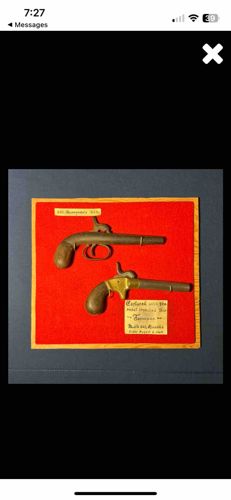
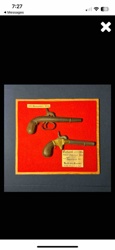
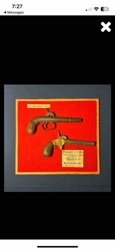
This display features two antique percussion deringers or miquelet-lock pistols mounted on a red velvet backing within a wooden frame, likely pine or similar light-colored wood. The overall dimensions appear to be approximately 12-18 inches in width and 8-12 inches in height, based on the scale of the pistols. Both pistols exhibit considerable patina and wear consistent with age, suggesting they are either original period pieces or very accurate replicas. The top pistol is entirely dark, likely cast iron or blued steel, with a simple, unadorned grip and basic trigger guard. Its surface shows oxidation and pitting, characteristic of untreated or poorly preserved ferrous metals. The bottom pistol, however, presents a striking contrast with a brass or possibly gilded steel receiver/lock plate area, which has developed a rich, aged yellow-gold patination. Its barrel is dark, similar to the top pistol, and its grip appears to be made of a dark wood, possibly walnut, showing minor wear and a smooth finish. Both pistols feature exposed hammers and triggers, typical of early percussion cap designs. There are handwritten labels underneath each pistol. The top label is small and mostly illegible, but the bottom label is larger and reads: "Caplock with Pin / (Model imported into / Tennessee / Black and White / 1850. P.R.R. & I.M.)." This suggests the bottom pistol is a 'Caplock' design, imported into Tennessee around 1850, and potentially associated with a 'Black and White' historical context or railway/industrial movement (P.R.R. & I.M.). The craftsmanship appears utilitarian but robust, indicative of weapons designed for personal defense or frontier use rather than elaborate ornamentation. The overall condition suggests historical significance with visible signs of age-related degradation, including surface rust, discoloration, and potential minor chipping on the wooden grip of the lower pistol. The display itself shows minor wear to the frame and backing, typical for a vintage display case.
AI Appraisal Report
Upon examining this display of two antique percussion deringers, my initial assessment is that they are likely mid-19th-century American or European-made pistols. The top pistol is a simple, utilitarian piece, showing significant oxidation, suggesting it's made of iron or steel. The bottom pistol is a more distinctive caplock design with a brass frame, which aligns with the handwritten note indicating an 1850s import to Tennessee. This note, while intriguing, is not a substitute for formal provenance and its claims require verification.
Condition is fair but degraded; both pistols show heavy patina, pitting, and wear consistent with their purported age. While visually compelling, this condition lowers the value compared to well-preserved examples. The market for mid-19th-century percussion pistols is stable, with higher values reserved for pieces with documented history, rare maker's marks, or exceptional condition. Common, unmarked pistols of this type typically have decorative or historical appeal rather than high collector value.
The most significant factor impacting value is authenticity. Based on images alone, I cannot confirm if these are original period firearms, later replicas, or composite pieces. The note itself could be a later addition. To authenticate these pistols, a physical examination is mandatory to search for maker's marks, proof marks, and serial numbers. Disassembly would be required to inspect internal mechanisms and construction techniques. Verifying the provenance mentioned in the note would involve historical research into Tennessee import records and entities like 'P.R.R. & I.M.' Without this verification, the pistols must be valued as decorative historical artifacts.