AI estimate as of October 27, 2025 · verify with a professional before acting
AI-Generated · Verify before acting
Everything on this page is generated by AI for informational purposes only. AI can make mistakes — the AI may misidentify items or misattribute them (artist, maker, brand, designer, origin, era). This is not an official valuation and should not be used for insurance, sale, tax, estate, legal, or lending purposes — or any decision requiring a certified appraisal. It is not an authoritative claim about any person, brand, or rights holder — do not share or rely on it as a factual statement about a third party. Always consult qualified professionals before making financial decisions.
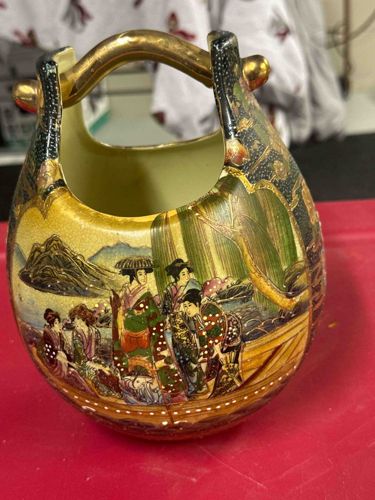
This item is an ornate Japanese ceramic ewer or basket-style vase, likely crafted in the Satsuma-style, characterized by its richly decorated earthenware with intricate details and often featuring gilt accents. The vase has a distinctive teardrop or pear-shaped body with a single, arching golden handle. The primary color palette includes earthy tones of gold, green, blue, brown, red, and black, with liberal use of gilt highlights that appear hand-painted. The exterior features a prominent pictorial scene depicting a group of Japanese geisha or noblewomen in traditional kimonos, gathered near what appears to be a boat or on the bank of a body of water. In the background, stylized mountains and textured fields or waves are visible, rendered with vertical brushstrokes in shades of green and brown. The details on the kimonos are very fine, adorned with small white dots and colored patterns. The overall surface of the vase possesses a crackled glaze effect, characteristic of Satsuma ware, contributing to its antique appearance. The gold handle is smooth and somewhat tarnished, indicating age and handling. The top edges where the handle connects to the body are decorated with black and gold stippling. The interior of the vase is a light, muted yellow or cream color. The visible condition suggests some patina consistent with age, and possible minor wear to the gilt details, but no obvious chips, cracks, or repairs are discernible from the provided images. The craftsmanship appears to be of good quality, with careful attention to the detailed painting and the decorative application of gold. This piece likely dates from the late 19th to early 20th century, a common period for the export of such Japanese ceramics.
AI Appraisal Report
This ornate Japanese Satsuma-style ewer/basket vase, richly decorated and featuring a geisha and mountain scene, presents as a charming example of late 19th to early 20th-century ceramic artistry. Visually, the condition appears good, with no obvious chips, cracks, or repairs, though some wear to the gilt is consistent with age. The characteristic crackled glaze and intricate hand-painted details, including the fine patterns on the kimonos and the stippling on the handle connections, speak to its craftsmanship. The golden arching handle and the earth-toned palette with liberal gilt accents are typical of Satsuma ware produced for export during the Meiji period.
Authenticity, based solely on images, appears reasonable for a Satsuma-style piece, however, definitive authentication requires a physical examination. I need to inspect for maker's marks, examine the quality of the earthenware body, and scrutinize the hand-painting details more closely to distinguish it from later imitations or mass-produced items. Provenance documentation would also greatly assist. Without such, it remains 'Satsuma-style.'
Market conditions for export Satsuma ware have seen fluctuations. While highly decorative, its widespread production means extreme rarity is uncommon unless by a renowned artist. Today, pieces of this quality and condition typically fall into a mid-range decorative category. Demand is steady among collectors of period Asian ceramics and decorative arts. Factors impacting value include the detailed narrative scene, the intact condition of the handle, and the overall aesthetic appeal. My valuation reflects its decorative merit and apparent good condition, acknowledging the limitations inherent in an image-based appraisal.