AI estimate as of September 22, 2025 · verify with a professional before acting
AI-Generated · Verify before acting
Everything on this page is generated by AI for informational purposes only. AI can make mistakes — the AI may misidentify items or misattribute them (artist, maker, brand, designer, origin, era). This is not an official valuation and should not be used for insurance, sale, tax, estate, legal, or lending purposes — or any decision requiring a certified appraisal. It is not an authoritative claim about any person, brand, or rights holder — do not share or rely on it as a factual statement about a third party. Always consult qualified professionals before making financial decisions.
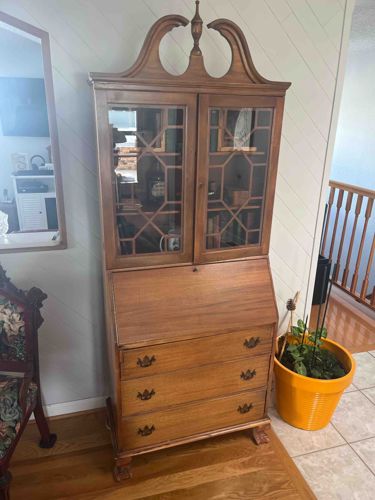
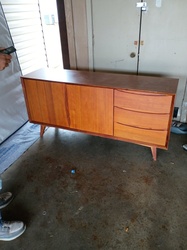
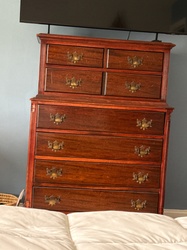
This is a Federal-style secretary desk with a hutch or china cabinet top, crafted from a warm-toned wood, likely mahogany or a similar fruitwood. The piece stands as a two-part unit, characteristic of its functional design. The upper section features a graceful broken arch pediment with a central flame finial, adding a classical touch. Beneath the pediment, there are two glass-fronted doors, each fitted with intricate geometric muntin patterns, suggestive of a Chippendale or Federal aesthetic. The glass appears clear, allowing visibility to the contents within. The lower section comprises a slant-front desk that, when opened, would reveal a writing surface and various pigeonholes or small drawers for organization, though these interior details are not visible in the current image. Below the desk portion are four graduated drawers, each adorned with a pair of brass pull handles, likely bails within a decorative backplate, possibly rococo or early American in style. The base of the unit features ogee bracket feet, a common and elegant support style for furniture of this period. The overall condition appears good for its age, with a consistent finish and no immediately obvious major damage such as cracks or significant losses. Some minor surface wear, discoloration, or patina appropriate for an older furniture piece may be present but is not distinctly visible. The craftsmanship suggests a manufactured piece from the mid-20th century, likely from the 1940s to 1960s, replicating an earlier traditional style. The joinery, while not visible, is expected to be dovetailed for quality construction common in such pieces. The size appears substantial, suitable for a study or dining area.
AI Appraisal Report
I have examined the provided image of this Federal-style secretary desk with a china cabinet top. Based on my visual assessment, the piece is crafted from a warm-toned wood, likely mahogany or a fruitwood, exhibiting a consistent finish that suggests good overall condition for its age. The design elements, such as the broken arch pediment with flame finial, geometric muntin patterns on the glass doors, graduated drawers with brass pull handles, and ogee bracket feet, are all consistent with a Federal aesthetic. However, the overall craftsmanship and a certain uniformity in its appearance lead me to believe this is a manufactured piece replicating an earlier traditional style, likely dating from the mid-20th century (1940s-1960s), rather than an authentic 18th or early 19th-century Federal original. Minor surface wear and patina are likely present but not clearly visible in the image. There are no signs of major damage such as cracks or significant losses.
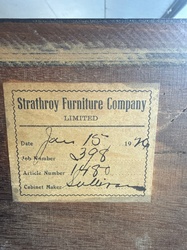
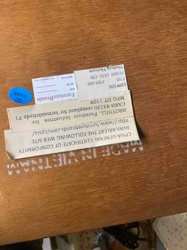
Market conditions for reproduction furniture, even well-made examples like this appears to be, are generally moderate. While such pieces offer functional utility and a classic aesthetic, they do not command the high values of genuine antiques. Comparables in this category typically fall into the modest to mid-range. Demand is steady for functional and aesthetically pleasing pieces for home decor, but rarity is not a significant factor here as similar reproductions were mass-produced. Factors impacting value include the solid wood construction, the completeness of the two-part unit, and its good visual condition. The primary limitation is that authenticity and precise age cannot be definitively determined from images alone. A physical inspection would be necessary to examine joinery (e.g., dovetailed drawers), the specific wood species, internal desk mechanisms, and the presence of any maker's marks or labels. Without such an in-person examination or provenance documentation, the possibility of it being an older, but restored, piece, or a newer, high-quality bespoke reproduction cannot be entirely ruled out, though the current assessment leans towards a mid-20th-century mass-produced item.