AI Appraisal Estimate

AI-generated estimates · not official valuations

From the user

What was submitted

Photo and notes provided by the user — not generated by AI

Submitted item photo
Submitted photo · June 4, 2026

User's notes

No additional notes provided.

AI analysis below

AI appraisal

AI analysis & estimate

AI-Generated · Verify before acting

Everything below is generated by AI for informational purposes only. AI can make mistakes — the AI may misidentify items or misattribute them (artist, maker, brand, designer, origin, era). This is not an official valuation and should not be used for insurance, sale, tax, estate, legal, or lending purposes — or any decision requiring a certified appraisal. It is not an authoritative claim about any person, brand, or rights holder — do not share or rely on it as a factual statement about a third party. Always consult qualified professionals before making financial decisions.

Read the full disclaimer

AI Identification

·Not independently authenticated·Verify before acting

1961 Lincoln Wheat Cent (One-Cent Coin)

Coin

AI Estimated Value

·Not an official valuation·Verify before acting

$0.05 - 0.10

As of June 4, 2026

AI Item Analysis

·AI can make mistakes·Verify before acting
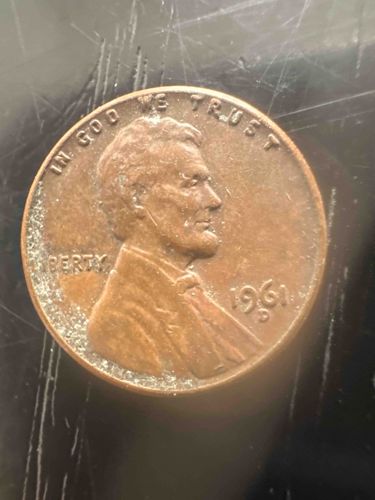
The item is a United States one-cent coin, commonly known as a Lincoln Wheat Cent, minted in 1961. The obverse prominently features a right-facing bust of Abraham Lincoln. The inscription "IN GOD WE TRUST" is arched above Lincoln's head, and the word "LIBERTY" is visible to his left, though partially obscured by what appears to be environmental residue or possibly corrosion. The mint date, "1961," is clearly visible to Lincoln's right. The coin is made of a copper-zinc alloy (the composition for Lincoln Cents changed to 95% copper, 5% zinc/tin from 1959-1962). Its color is consistent with aged copper, exhibiting a brownish-orange patina. The surface shows notable wear consistent with circulation, particularly on the higher points of Lincoln's effigy, such as his cheekbone and forehead, which appear somewhat flattened. There are significant areas of white, possibly powdery or crystalline residue, particularly around the lower left quadrant of the obverse, encompassing parts of the rim and the 'LIBERTY' inscription. This residue suggests environmental exposure or possible improper storage, and its presence detracts from the coin's aesthetic and potential numismatic value, as it could indicate surface corrosion or environmental damage. The rim appears mostly intact but shows some minor abrasions. No distinct mint mark is visible in the provided image, which for a 1961 Lincoln Cent would typically be below the date (though the absence of a mint mark typically signifies the Philadelphia Mint). The craftsmanship is characteristic of standard US coinage for the era. The overall condition is fair to good, but the notable surface residue/corrosion is a significant condition issue. Its age places it within the mid-20th century.

AI Appraisal Report

·AI can make mistakes·Verify before acting
I have examined the provided image of this 1961 Lincoln Wheat Cent. The coin appears authentic, consistent with standard US coinage of the era, displaying Abraham Lincoln's effigy and the correct date. Without a visible mint mark, it is presumed to be from the Philadelphia Mint. The condition is fair to good, exhibiting considerable circulation wear, particularly on Lincoln's higher facial features. The most significant factor impacting its value is the notable white residue, possibly environmental damage or corrosion, especially prominent on the lower left obverse and near 'LIBERTY.' This heavily detracts from its aesthetic appeal and numismatic grade. Lincoln Cents from 1961 are extremely common, with billions minted. This high mintage means they typically hold little value in circulated condition unless they possess specific errors or exceptional grades (Uncirculated or higher). Market demand for common date circulated Lincoln Cents like this is very low, primarily limited to beginner collectors or as novelty items. Comparables in similar circulated condition, without the extensive residue, typically sell for a few cents. Therefore, the primary factors driving down the value are the common date, extensive circulation wear, and the significant surface residue/damage. For a full authentication and definitive condition assessment, an in-person examination is crucial to determine the exact nature of the residue (e.g., PVC damage, environmental corrosion, or foreign material) and its permanence. Without physical inspection, the extent of underlying surface damage cannot be fully ascertained, and thus the true impact on its long-term preservation and collector appeal remains somewhat speculative. No scientific testing or provenance documentation would be required for a common coin like this, only physical inspection.

Get your items appraised

Instant estimates of your treasures with AI-powered appraisals

Browse More Appraisals