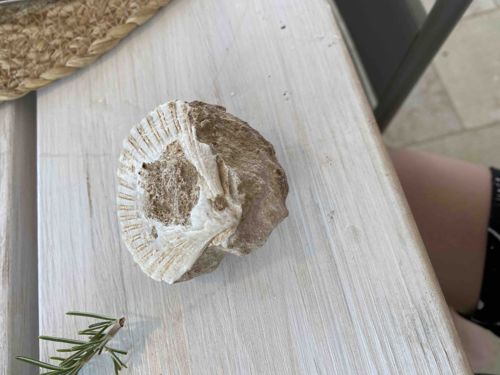
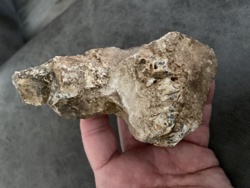
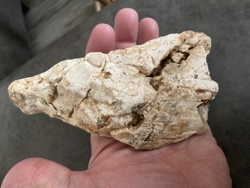
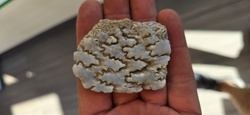
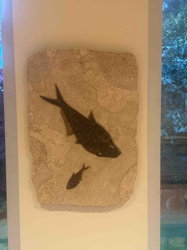
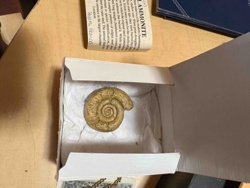
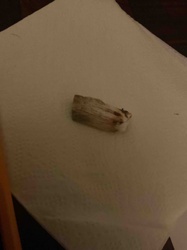
Random rock found in 72015 Fasano BR Italy with embedded seashell; possibly travertine or andesite
These notes were written by the person who submitted this item. Appraiser.AI has not verified them, and the AI's identification and estimate may rely on them.
AI Estimated Value
Not an official valuation
$40-$75
AI estimate as of August 11, 2025 · verify with a professional before acting
AI-Generated · Verify before acting
Everything on this page is generated by AI for informational purposes only. AI can make mistakes — the AI may misidentify items or misattribute them (artist, maker, brand, designer, origin, era). This is not an official valuation and should not be used for insurance, sale, tax, estate, legal, or lending purposes — or any decision requiring a certified appraisal. It is not an authoritative claim about any person, brand, or rights holder — do not share or rely on it as a factual statement about a third party. Always consult qualified professionals before making financial decisions.
This analysis also relies on unverified notes provided by the user, which may be incomplete or inaccurate and could affect the result.
This item is a geological specimen, specifically a natural rock formation with an embedded fossilized seashell. The rock itself appears to be a light brown to grayish-brown sedimentary structure, possibly limestone or a similar mineral given the presence of a marine fossil and the location context (Fasano, Italy). The texture of the rock is rough and uneven, indicative of natural weathering and formation. The most prominent feature is the clearly visible embedded bivalve seashell. The fossilized shell exhibits distinct radial ridges or ribs extending from the hinge point towards the outer margin, which are characteristic of certain bivalve species such as scallops or cockles. The shell's original color has been effaced by the fossilization process, appearing as a whitish to light cream color that contrasts with the darker surrounding rock matrix. Part of the shell's interior is visible, showing a coarse, granular infill, likely composed of the same sediment that formed the rock. The fossil appears to be well-preserved, though some areas of the shell's outer edges seem to have fractured or eroded, blending into the rock. There are no discernible maker's marks, signatures, or stamps, as this is a natural formation. Based on the geological activity and history of the Puglia region where Fasano is located, such fossils are common in Cretaceous to Cenozoic marine sedimentary deposits. The condition of the specimen is natural, with expected imperfections from fossilization and geological processes, including minor chips and exposed matrix. Its quality is determined by the clarity of the fossil's features against the matrix, which is quite good.
AI Appraisal Report
Upon examining the provided image and description of this fossilized seashell embedded in rock, I can confirm its authenticity as a natural geological specimen. The visible bivalve shell, with its distinct radial ridges and integration into the sedimentary matrix, is consistent with natural fossilization processes. The rock's texture and color are also in line with typical sedimentary formations found in marine environments. The location, Fasano, Italy, is a region known for rich fossil deposits, further supporting its natural origin. I assess its condition as good for a natural specimen, exhibiting expected wear, minor chips, and erosion consistent with geological processes. There are no signs of artificial manipulation or fabrication.
From images alone, a definitive identification of the rock type (travertine vs. andesite) is challenging, though the presence of a marine fossil strongly suggests a sedimentary origin like limestone or travertine over igneous rock like andesite. The specific bivalve species also cannot be precisely identified without closer paleontological examination. For full authentication and scientific classification, an in-person examination, including potential geological testing (e.g., acid test for carbonates, thin section analysis), and detailed paleontological study of the fossil's morphology would be required. Provenance documentation, while not present for a 'random rock,' would ideally trace its discovery and collection if it were being considered for a significant institutional acquisition.
Regarding market conditions, common fossils like bivalves, especially those from well-known fossil localities, generally fall into the affordable to mid-range category for collectors. While interesting, this particular specimen does not exhibit extraordinary size, rarity of species, or exceptional preservation that would command a premium. "Random rocks" tend to have lower value than professionally excavated and documented specimens. Demand exists among amateur collectors, educational institutions, and interior decorators. Compared to more rare or detailed fossils (e.g., trilobites, dinosaur bones, or exquisitely preserved ammonites), this piece is quite common.
Factors impacting value include its good preservation for a bivalve, the clear contrast between the fossil and matrix, and its natural aesthetics. However, its commonality, lack of scientific documentation, and unknown precise geological context limit its value. It lacks the rarity, scientific significance, or aesthetic perfection that would drive a higher price point in the specialized fossil market.