AI estimate as of December 15, 2025 · verify with a professional before acting
AI-Generated · Verify before acting
Everything on this page is generated by AI for informational purposes only. AI can make mistakes — the AI may misidentify items or misattribute them (artist, maker, brand, designer, origin, era). This is not an official valuation and should not be used for insurance, sale, tax, estate, legal, or lending purposes — or any decision requiring a certified appraisal. It is not an authoritative claim about any person, brand, or rights holder — do not share or rely on it as a factual statement about a third party. Always consult qualified professionals before making financial decisions.
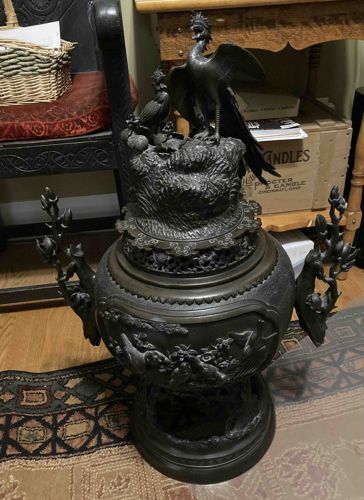
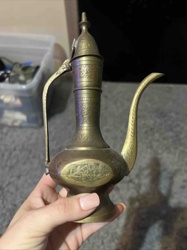
This is a large, ornate Japanese bronze koro, or censer, featuring intricate sculptural and relief work. The koro is composed of several interlocking sections, cast in a dark, possibly patinated bronze with a matte finish. The overall form is substantial, suggesting considerable weight. The base is circular and stepped, supporting a bulbous central body. This central body is extensively decorated with high-relief scenes depicting what appear to be dragons or mythical beasts amidst foliage or clouds, characteristic of traditional East Asian motifs. Two substantial handles protrude from the sides of the central body, fashioned into complex floral or branch-like designs with buds or leaves at their ends. Above the central body, there is a reticulated or pierced lid, allowing for the diffusion of incense smoke. The most striking feature is the finial, which consists of a sculpted scene of a large phoenix with outstretched wings and a smaller bird, possibly a crane or another mythical bird, perched on a rocky or mountainous formation. The details on the birds, including their feathers and crests, are finely rendered. The surfaces show some areas of dust and a slight dullness to the patina, indicative of age and typical wear from display. There are no immediately visible major damages such as cracks or repairs, though a closer inspection would be needed to confirm this. The craftsmanship appears to be of high quality, demonstrating skilled bronze casting and finishing techniques, suggesting a piece from the late 19th to early 20th century, likely Meiji period or early Showa. The intricate details and multi-component construction speak to a significant investment of time and artistic skill.
AI Appraisal Report
Based on my visual examination of the provided image, this Japanese bronze koro is a magnificent example of late 19th to early 20th-century decorative arts, likely dating to the Meiji period or early Showa. The condition appears to be good for its age, exhibiting a desirable dark patination with a matte finish. I note some dust and slight dullness, which are consistent with age and display, but no overt signs of significant damage like cracks or repairs are visible from the image. The high quality of the casting, intricate relief work depicting dragons and mythical beasts, and the finely sculpted phoenix and smaller bird finial are indicative of skilled craftsmanship and attention to detail.
From the image, the authenticity appears strong, characteristic of Japanese export ware from this period. However, without a physical inspection, I cannot confirm the bronze alloy, internal construction, or presence of any maker's marks or signatures, which would significantly aid in full authentication and attribution. Market conditions for fine Japanese bronzes from this period remain robust, particularly for large, elaborate pieces with mythological motifs. Comparables typically include other high-quality koro or censer forms with detailed figural or animal finials. The rarity of such a large and ornately decorated piece, combined with its apparent quality, contributes positively to its value.
Factors significantly impacting value include the substantial size, the multi-component construction, and the detailed sculptural elements. Any restoration, undisclosed damage, or a non-period bronze composition would negatively impact the appraisal. To fully verify authenticity and precise dating, a physical examination allowing for inspection of the underside, internal components, close-up analysis of casting techniques, and potential identification of maker's marks would be essential. Provenance documentation, if available, would also greatly enhance the item's value and confirm its history.