AI Appraisal Estimate

AI-generated estimates · not official valuations

From the user

What was submitted

Photo and notes provided by the user — not generated by AI

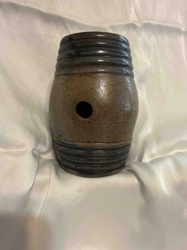
Submitted item photo
Submitted photo · May 25, 2026

User's notes

No additional notes provided.

AI analysis below

AI appraisal

AI analysis & estimate

AI-Generated · Verify before acting

Everything below is generated by AI for informational purposes only. AI can make mistakes — the AI may misidentify items or misattribute them (artist, maker, brand, designer, origin, era). This is not an official valuation and should not be used for insurance, sale, tax, estate, legal, or lending purposes — or any decision requiring a certified appraisal. It is not an authoritative claim about any person, brand, or rights holder — do not share or rely on it as a factual statement about a third party. Always consult qualified professionals before making financial decisions.

Read the full disclaimer

AI Identification

·Not independently authenticated·Verify before acting

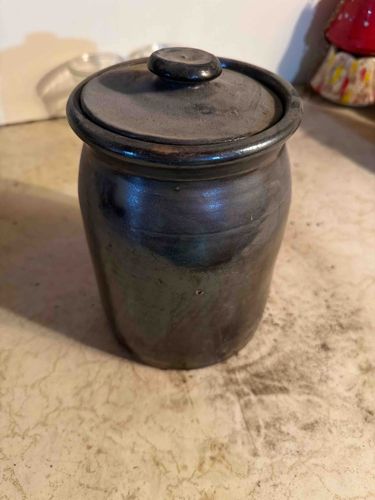
Albany-Slipped or Manganese Glazed Stoneware Preserve Jar with Lid

Antique American Stoneware / Primitive Pottery

AI Estimated Value

·Not an official valuation·Verify before acting

$175.00 - $250.00

As of May 25, 2026

AI Item Analysis

·AI can make mistakes·Verify before acting
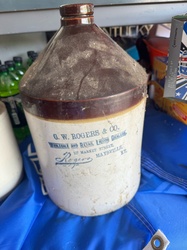
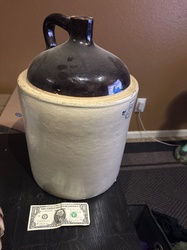
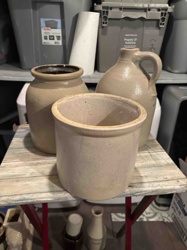
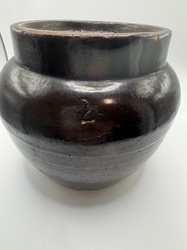
This item is a wheel-thrown stoneware storage jar, likely used for preserves or butter, featuring a matching inset lid with a singular central knob. The jar stands approximately 6 to 8 inches tall and possesses a slightly ovoid or cylindrical form with a flared rim. Its exterior is finished in a dark, metallic glaze that ranges from deep chocolate brown to charcoal black, charactaristic of an Albany slip or a high-iron/manganese glaze. The surface exhibits a subtle iridescence and slight variations in texture common in 19th-century utilitarian pottery. Notable features include horizontal throwing rings visible under the glaze and a well-defined gallery for the lid to sit within. In terms of condition, there is several minor rim chips and surface abrasions consistent with age and domestic use, particularly around the edges of the lid and the lip of the jar. No maker's marks are visible in this orientation, but the craftsmanship suggests a Mid-to-Late 19th-century American or European origin. The heavy glaze application and sturdy construction indicate high durability and quality for everyday household use during the period.
AI Appraisal Report

·AI can make mistakes·Verify before acting
I have examined the provided description and image of the wheel-thrown stoneware preserve jar. The piece exhibits characteristic traits of mid-to-late 19th-century American utilitarian pottery, specifically a dark Albany-type slip glaze. The presence of horizontal throwing rings and the specific 'gallery' rim construction for the inset lid are indicative of period craftsmanship. The metallic, iridescent quality of the manganese/iron glaze suggests a high-firing temperature, likely in a wood-fired kiln, which adds to its aesthetic appeal for collectors of primitive Americana. The current market for utilitarian stoneware remains steady, though values are heavily dictated by the presence of a maker’s mark or regional stylistic markers (such as those from the Edgefield or Ohio River Valley schools). As this piece lacks a visible mark, its value is based primarily on its form and the rare survival of its original matching lid. Condition issues, specifically the chips on the rim and lid, are typical for domestic 'kitchen' antiques but do negatively impact the ceiling price. Comparables for unmarked miniature or mid-sized jars with lids typically hammer between $150 and $250 at regional auctions. Rare cobalt decoration would increase this significantly; however, the monochromatic Albany slip is more common. Limitations: This appraisal is based on photographic evidence only. Authenticity cannot be fully guaranteed without a physical tactile inspection to confirm the weight, bottom wear patterns, and the 'tongue' test for glaze stability. In-person examination is required to rule out 20th-century 'revival' pieces or modern reproductions. Provenance documentation regarding its original find-site would significantly aid in regional attribution and potentially increase the valuation.

Get your items appraised

Instant estimates of your treasures with AI-powered appraisals

Browse More Appraisals