AI Appraisal Estimate

AI-generated estimates · not official valuations

From the user

What was submitted

Photo and notes provided by the user — not generated by AI

Submitted item photo
Submitted photo · June 8, 2026

User's notes

No additional notes provided.

AI analysis below

AI appraisal

AI analysis & estimate

AI-Generated · Verify before acting

Everything below is generated by AI for informational purposes only. AI can make mistakes — the AI may misidentify items or misattribute them (artist, maker, brand, designer, origin, era). This is not an official valuation and should not be used for insurance, sale, tax, estate, legal, or lending purposes — or any decision requiring a certified appraisal. It is not an authoritative claim about any person, brand, or rights holder — do not share or rely on it as a factual statement about a third party. Always consult qualified professionals before making financial decisions.

Read the full disclaimer

AI Identification

·Not independently authenticated·Verify before acting

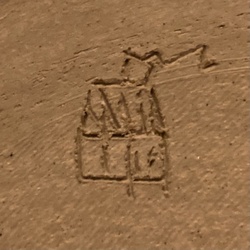
Pottery Maker's Mark with Menorah-like Symbol

Pottery Mark

AI Estimated Value

·Not an official valuation·Verify before acting

$5 - $15

As of June 8, 2026

AI Item Analysis

·AI can make mistakes·Verify before acting
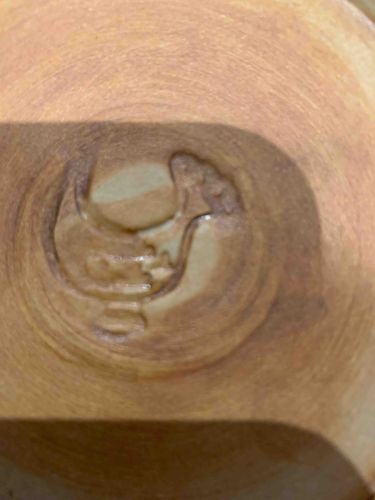
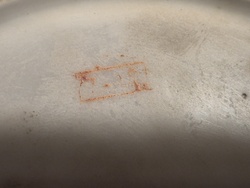
This image captures a close-up detail of a maker's mark or impressed stamp found on the underside or back of a piece of pottery. The mark is deeply impressed into the ceramic material, creating a clear, raised design against a recessed background. The primary feature of the mark is a stylized symbol resembling a menorah, a seven-branched candelabrum, although it could also be interpreted as a more generic candelabrum or even an abstract tree-like form with multiple arms extending upwards from a central base. The material itself appears to be unglazed or bisque-fired ceramic, possibly earthenware, exhibiting a warm, earthy tone ranging from light tan to a reddish-brown, indicative of the clay body and potentially some subtle firing effects or a subsequent wash. The surface surrounding the impressed mark shows characteristic concentric circles, suggesting it was formed on a potter's wheel, a common technique for shaping ceramic vessels. There are no visible signs of glaze, cracks, chips, or significant wear within the immediate area of the mark, suggesting either a well-preserved piece or a protected area of the object. The edges of the impressed design are relatively crisp, indicating a well-defined stamp was used during the greenware stage. The overall impression suggests a handcrafted origin, likely dating from the mid-20th century to contemporary, given the clear impression and the symbol's design. The quality of the impression appears to be good, indicating a deliberate and careful application of the mark.
AI Appraisal Report

·AI can make mistakes·Verify before acting
Upon examining the provided image of this potter's mark, I am assessing the mark itself, not a complete ceramic piece. The mark is a stylized symbol resembling a menorah or candelabrum, impressed into what appears to be an unglazed earthenware body. The impression is clear and well-defined, suggesting a deliberate application on greenware. The concentric turning rings surrounding it confirm the piece was wheel-thrown. Based on the style, it likely originates from a mid-20th century to contemporary studio potter. The critical factor impacting value is that this is only a mark, detached from the artwork it was meant to identify. Without the full object (vase, bowl, etc.), the mark has negligible intrinsic or artistic value. Its worth is purely informational, and only to a researcher or collector trying to identify this specific potter. The market for isolated pottery marks is virtually nonexistent. For comparison, complete, signed studio pottery pieces can range from under fifty dollars to thousands, but a fragment or just a photo of a mark does not carry this value. Demand for an unidentified mark is extremely low. Ultimately, the value provided reflects the informational potential for a researcher, not an art or collectible value. For full authentication, I would need to examine the entire piece in person to assess its form, function, glaze, and overall artistry. This would allow for potential identification by cross-referencing against databases of studio pottery marks. Without the complete object, no meaningful appraisal beyond this minimal informational value is possible.

Get your items appraised

Instant estimates of your treasures with AI-powered appraisals

Browse More Appraisals