AI Appraisal Estimate

AI-generated estimates · not official valuations

From the user

What was submitted

Photo and notes provided by the user — not generated by AI

Submitted item photo
Submitted photo · June 19, 2026

User's notes

No additional notes provided.

AI analysis below

AI appraisal

AI analysis & estimate

AI-Generated · Verify before acting

Everything below is generated by AI for informational purposes only. AI can make mistakes — the AI may misidentify items or misattribute them (artist, maker, brand, designer, origin, era). This is not an official valuation and should not be used for insurance, sale, tax, estate, legal, or lending purposes — or any decision requiring a certified appraisal. It is not an authoritative claim about any person, brand, or rights holder — do not share or rely on it as a factual statement about a third party. Always consult qualified professionals before making financial decisions.

Read the full disclaimer

AI Identification

·Not independently authenticated·Verify before acting

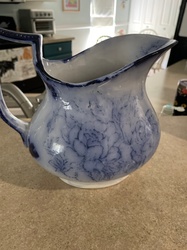
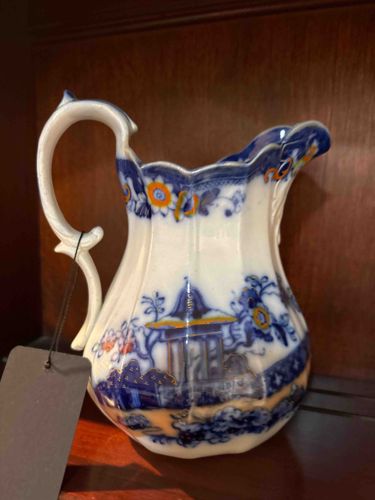
Victorian Era Flow Blue and Polychrome Chinoiserie Ironstone Pitcher

Antiques / Ceramics & Pottery

AI Estimated Value

·Not an official valuation·Verify before acting

$150 - $250

As of June 19, 2026

AI Item Analysis

·AI can make mistakes·Verify before acting
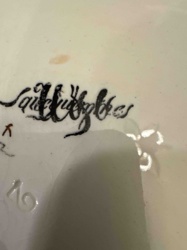
This is a mid-to-late 19th-century ceramic pitcher, likely produced in England (Staffordshire region) around 1850-1880. The item is constructed from heavy white ironstone or earthenware, featuring a distinct lobed or paneled body that flares slightly at the base and tapers toward a scalloped rim. The design utilizes the 'Flow Blue' transfer-ware technique, characterized by the deliberate blurring of the deep cobalt blue pigment into the surrounding glaze. This specific piece is further enhanced with 'clobbered' hand-painted polychrome accents in burnt orange and gold gilt, depicting a classic Chinoiserie scene with a central pagoda, stylized trees, and floral borders. The ornate, high-arched handle includes a prominent thumb rest and scroll-form terminal, indicating a high level of Victorian craftsmanship. Structurally, the pitcher appears stable, though there is visible crazing to the glaze consistent with age, and minor rubbing is evident on the gold gilt highlights and the orange enamel blossoms. No major cracks or chips are immediately visible in the image, though a slight yellowish patina suggests the piece has aged naturally. The base likely contains a potter's mark or name of the pattern, typical for ironstone of this period. This pitcher serves as a primary example of aesthetic movement pottery, blending European production techniques with Orientalist design motifs.
AI Appraisal Report

·AI can make mistakes·Verify before acting
I have examined the digital image of what appears to be a mid-to-late 19th-century Staffordshire ironstone pitcher, likely dating from 1850-1880. The piece features a desirable combination of Flow Blue transferware with polychrome 'clobbering'—hand-painted overglaze accents in burnt orange and gilt luster. This Chinoiserie motif, featuring pagodas and stylized floral elements, aligns perfectly with the Victorian fascination for Orientalist designs. The form itself, with its lobed panelling and high-scrolled handle, is characteristic of Staffordshire makers like Mason's or their contemporaries. Condition-wise, the visible crazing is consistent with ironstone of this age and adds a layer of authenticity rather than detracting significantly from value. There is distinct wear to the gilt highlights and rubbing on the orange enamel, which is expected for a utilitarian piece over 140 years old. I do not observe catastrophic cracks or chips in the image, though the yellowing patina suggests natural aging. The market for Flow Blue remains stable but selective; collectors specifically hunt for unusual forms and the rarer polychrome variants over standard blue-and-white. While standard Flow Blue pitchers often fetch $100-$150, the polychrome addition elevates this piece. However, 'clobbered' wares can be polarizing—some purists prefer the original transfer. It is critical to note that without physical handling, I cannot verify the maker's mark on the base or detect professional restoration (such as filled chips or repainted handles), which would drastically reduce value. A tactile inspection is needed to check for hairline fractures in the handle and to weigh the density of the ironstone. Provenance regarding its acquisition history would further solidify its attribution.

Get your items appraised

Instant estimates of your treasures with AI-powered appraisals

Browse More Appraisals