AI estimate as of September 27, 2025 · verify with a professional before acting
AI-Generated · Verify before acting
Everything on this page is generated by AI for informational purposes only. AI can make mistakes — the AI may misidentify items or misattribute them (artist, maker, brand, designer, origin, era). This is not an official valuation and should not be used for insurance, sale, tax, estate, legal, or lending purposes — or any decision requiring a certified appraisal. It is not an authoritative claim about any person, brand, or rights holder — do not share or rely on it as a factual statement about a third party. Always consult qualified professionals before making financial decisions.
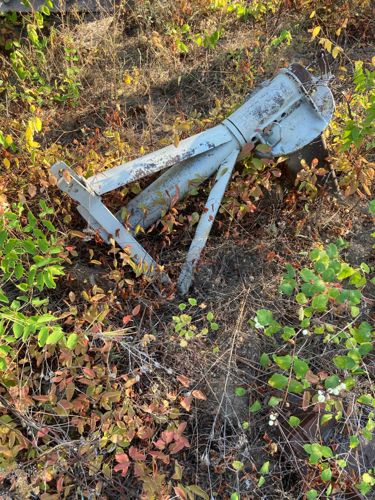
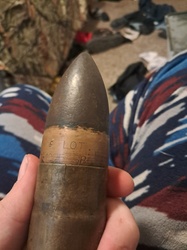
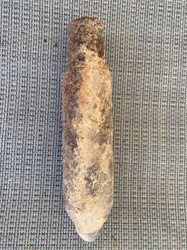
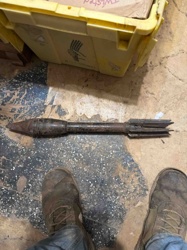
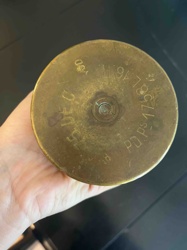
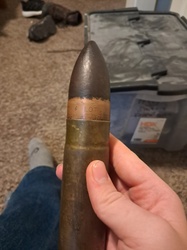
The item appears to be a section of a rocket motor or a similar projectile, characterized by its cylindrical main body and attached stabilizer fins. The primary material seems to be metal, likely aluminum or steel, given the observed tarnishing and wear patterns. The item's color is a faded light grey or off-white, suggesting either an original paint finish that has weathered considerably or the natural color of oxidized metal. Three distinct stabilizer fins, triangular in cross-section and tapering towards their ends, are attached radially around the rear cylindrical portion. These fins exhibit significant surface rust, chipping paint, and general degradation, consistent with exposure to the elements and potential impact. A band or ring encircles the cylindrical body just forward of the fin attachment points, secured by what looks like a bolted or riveted connection, which may have served to hold the fins in place or connect to another section of the projectile. The overall condition indicates that the item has been discarded or has fallen from a greater height, showing dents, scratches, and ground-in dirt, particularly on the underside where it rests amidst vegetation. The craftsmanship appears utilitarian and robust, typical of military or industrial applications, rather than decorative. There are no visible markings, serial numbers, or manufacturer's stamps that would aid in precise identification. Based on the degradation and utilitarian design, it is likely modern military surplus or ordnance, possibly from a rocket-propelled grenade (RPG) or unguided rocket, and could date from the mid-20th century to the present day due to the commonality of such designs.
AI Appraisal Report
Upon visual examination of the provided image, this item, identified as a Rocket Motor Section with Stabilizer Fins, appears to be military ordnance debris. Its condition is poor, exhibiting significant surface rust, chipping paint, dents, scratches, and embedded dirt, consistent with prolonged environmental exposure and potential impact. The utilitarian design and lack of decorative elements strongly suggest its original function was military or industrial. While the craftsmanship appears robust, typical of such applications, the absence of any visible markings, serial numbers, or manufacturer's stamps makes definitive authenticity and origin verification challenging based solely on photographic evidence.
Market conditions for military ordnance debris of this type are generally low. Unless directly linked to a historically significant event or a rare, identifiable projectile, such items typically hold minimal monetary value. Comparables would include other discarded projectile components or scrap metal, which are usually sold by weight or as curiosities rather than collectible artifacts. Demand is niche, primarily among collectors of military artifacts or those interested in historical ordnance, but only if provenance or specific identification can be established. Without such information, its rarity is not a significant factor; similar unidentifiable debris is common.
Factors significantly impacting value are the lack of identifiable markings, its degraded condition, and the absence of any known historical context or provenance. Without specific identification (e.g., type of rocket, era, country of origin) or a documented history, it remains largely inert scrap metal with limited collectible appeal. For a full authentication and more precise valuation, an in-person examination would be critical to search for any faint markings, assess material composition, and potentially identify manufacturing techniques. Provenance documentation or scientific analysis (e.g., metallurgical testing) would be required to confirm its origin and potential historical significance, which would be the primary drivers of any substantial increase in value.