AI Appraisal Estimate

AI-generated estimates · not official valuations

From the user

What was submitted

Photo and notes provided by the user — not generated by AI

Submitted item photo
Submitted photo · May 18, 2026

User's notes

No additional notes provided.

AI analysis below

AI appraisal

AI analysis & estimate

AI-Generated · Verify before acting

Everything below is generated by AI for informational purposes only. AI can make mistakes — the AI may misidentify items or misattribute them (artist, maker, brand, designer, origin, era). This is not an official valuation and should not be used for insurance, sale, tax, estate, legal, or lending purposes — or any decision requiring a certified appraisal. It is not an authoritative claim about any person, brand, or rights holder — do not share or rely on it as a factual statement about a third party. Always consult qualified professionals before making financial decisions.

Read the full disclaimer

AI Identification

·Not independently authenticated·Verify before acting

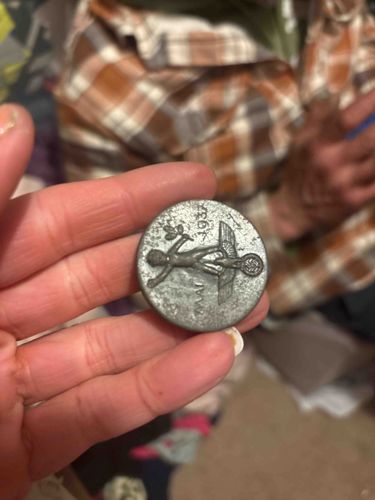
1937 German May Day (Tag der Arbeit) Tinnie Pin

Military Memorabilia / Historical Ephemera

AI Estimated Value

·Not an official valuation·Verify before acting

$15.00 - $25.00

As of May 18, 2026

AI Item Analysis

·AI can make mistakes·Verify before acting
This is a circular German commemorative badge, commonly known as a 'tinnie,' produced for the May Day (Day of Labor) national holiday in 1937. The item is approximately 35mm in diameter and is struck from a non-precious base metal, likely aluminum or a zinc alloy (Kriegsmetall), featuring a dull grey, matte patina. The design depicts a central figure representing the common worker or youth holding a sprig of oak leaves, standing atop a stylized German national eagle with outstretched wings (Reichsadler), which clutches a wreathed swastika. To the right of the figure is the date '1937' and to the left is the word 'MAI'. The strike shows moderate wear, with softening of the facial features and the eagle's plumage. The surface exhibits characteristic oxidation and minor pitting consistent with age. Such pins were mass-produced for participants of the 1st of May rallies during the Third Reich era. While the reverse is not visible, these typically feature a soldered horizontal safety pin for attachment and may contain a RZM maker's mark or manufacturer's name. The craftsmanship is utilitarian, reflecting its nature as a mass-distributed propaganda ephemeral item rather than high jewelry.
AI Appraisal Report

·AI can make mistakes·Verify before acting
I have conducted a visual examination of the 1937 'Tag der Arbeit' (Day of Labor) commemorative badge. This piece is a classic example of a German Third Reich 'tinnie' (Veranstaltungsabzeichen). The strike appears consistent with aluminum alloy production methods of the mid-1930s. The obverse displays moderate wear with softened details on the central figure and the Reichsadler, alongside a characteristic matte grey patina and minor surface oxidation. While these wear patterns are consistent with an authentic period piece, the ubiquity of high-quality reproductions in the militaria market necessitates caution. The market for 1937 May Day tinnies is highly saturated due to the massive quantities produced for the national holiday. These were meant to be worn once and kept as mementos; consequently, they do not possess the rarity of combat awards or elite political decorations. Recent auction comparables and dealer inventories consistently value these between $15 and $25 depending on the presence of a functional pin and a legible RZM or manufacturer mark on the reverse. Factors limiting value include the commonality of the 1937 design and the visible softening of the strike. Full authentication is impossible via digital image alone. A definitive appraisal would require a physical inspection to verify the metal's weight, the attachment method of the pin back (soldered vs. crimped), and under-magnification analysis of the edge tool marks to rule out modern cast copies. Documentation of provenance or a 'bring-back' history would add historical interest but would not significantly elevate the market price of such a mass-produced ephemeral item.

Get your items appraised

Instant estimates of your treasures with AI-powered appraisals

Browse More Appraisals