These notes were written by the person who submitted this item. Appraiser.AI has not verified them, and the AI's identification and estimate may rely on them.
AI Estimated Value
Not an official valuation
$60-90
AI estimate as of July 5, 2025 · verify with a professional before acting
AI-Generated · Verify before acting
Everything on this page is generated by AI for informational purposes only. AI can make mistakes — the AI may misidentify items or misattribute them (artist, maker, brand, designer, origin, era). This is not an official valuation and should not be used for insurance, sale, tax, estate, legal, or lending purposes — or any decision requiring a certified appraisal. It is not an authoritative claim about any person, brand, or rights holder — do not share or rely on it as a factual statement about a third party. Always consult qualified professionals before making financial decisions.
This analysis also relies on unverified notes provided by the user, which may be incomplete or inaccurate and could affect the result.
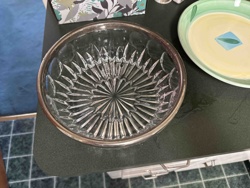
This is a clear pressed glass sugar and creamer set, likely dating from the late 19th to early 20th century. Both pieces exhibit an intricate radiating star and fan pattern, characteristic of the 'Early American Pattern Glass' (EAPG) era, specifically the 'American Brilliant' period influence or one of its popular imitators. The design features a large central star motif on each of the four main panels, surrounded by a densely packed 'hobnail' or diamond-point pattern in some areas, and a finer cross-hatch or waffle pattern in others. The top rim of both pieces is scalloped or flared, adding to their decorative appeal. The handles are simple, clear glass loops, smoothly integrated into the body. The creamer has a distinct pour spout, while the sugar bowl has two handles and a wider opening. The base of each piece appears to feature a starburst or sunburst pattern. The glass itself is clear with good transparency and a certain thickness, common in pressed glass items for durability. There are no visible chips, cracks, or significant wear captured in the image, suggesting good overall condition. No specific maker's marks are discernible from the provided image, which is common for many EAPG pieces.
AI Appraisal Report
Upon examining the provided image of this clear pressed glass sugar and creamer set, I assess its condition as excellent. There are no visible chips, cracks, or significant abrasions on either piece, which is commendable for items of this probable age. The intricate radiating star and fan pattern, typical of the EAPG era, is well-defined and sharp, suggesting good preservation of the mold details. Its authenticity as a late 19th to early 20th-century pressed glass set is highly probable given the pattern complexity, glass clarity, and common design elements for the period, particularly its resemblance to patterns influenced by the 'American Brilliant' cut glass era. The simple loop handles and scalloped rims further support this attribution.
Market conditions for EAPG sets, while not as robust as in past decades, still show consistent demand for well-preserved, attractive patterns. Comparables for complete, undamaged sugar and creamer sets in popular patterns typically range. This particular 'Radiating Star and Fan' pattern is visually appealing and highly decorative, which enhances its marketability. It is not exceedingly rare, but finding a matching, intact set in this condition is becoming less common.
Factors significantly impacting value include its excellent condition, the completeness of the set, and the enduring aesthetic appeal of the geometric pattern. The absence of maker's marks is typical for EAPG and does not negatively impact value.
Limitations in authenticity verification exist solely due to the image format. While the visual evidence strongly supports its age and type, a full authentication would require in-person examination to assess the tactile quality of the glass, seam lines indicative of pressed glass manufacturing, and microscopic analysis for subtle wear patterns. Provenance documentation (if available) would confirm ownership history, and while not strictly necessary for authentication of the glass itself, it can add historical value.