Carved Wood Fijian Waseisei Throwing Club (Ula)
Ethnographic Arms and Armor / or Tribal Art

Carved Wood Fijian Waseisei Throwing Club (Ula)

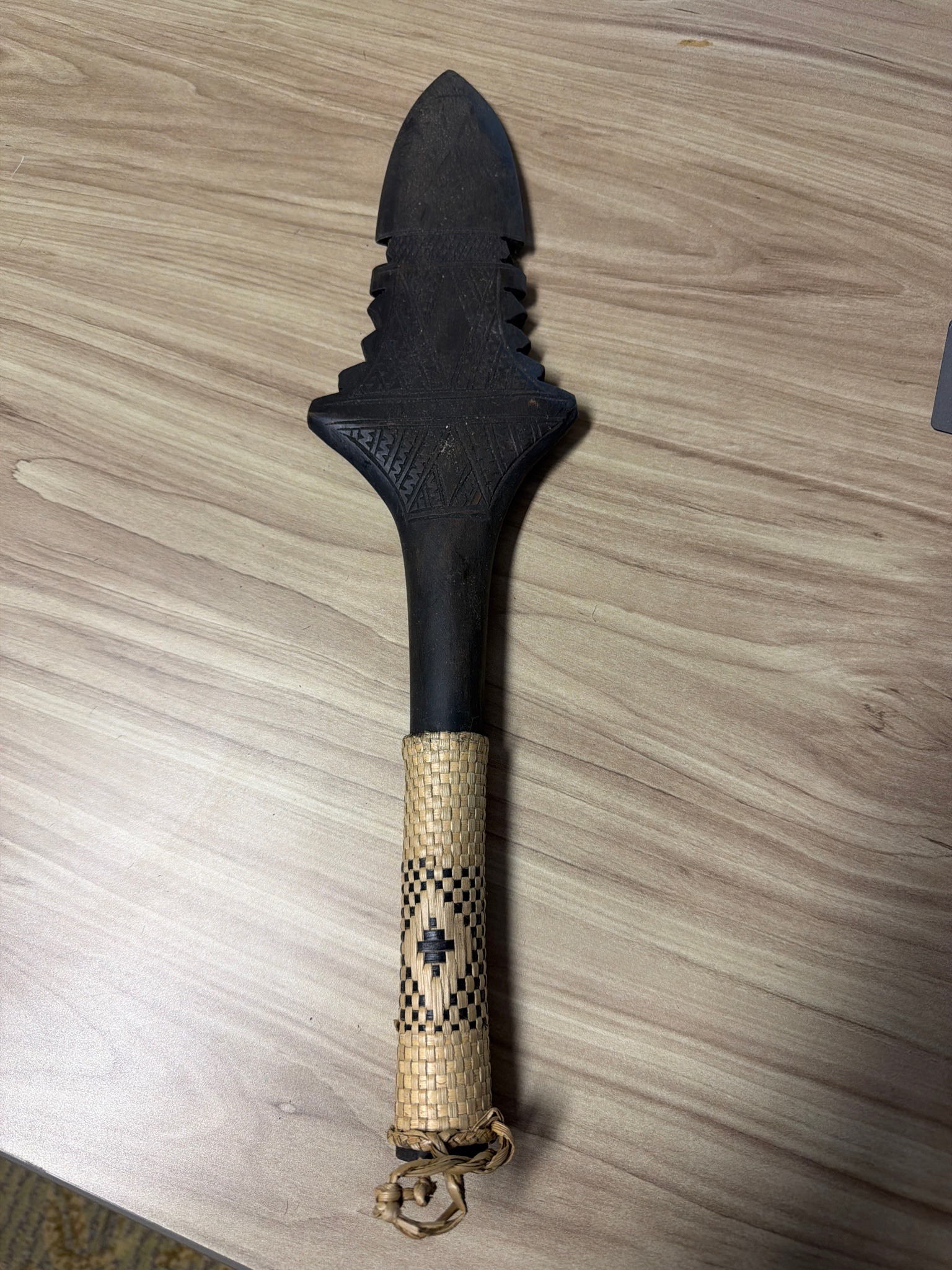
This item is a traditional Fijian throwing club, commonly referred to as an 'Ula' or specifically a 'Waseisei' style due to its distinct jagged, serrated head. It is hand-carved from a single piece of dense, dark hardwood, likely ironwood (Vesi), which is prized for its weight and durability. The head features a bulbous, diamond-shaped profile with deeply incised notches along the edges and geometric 'tavatava' patterns consisting of zig-zags and cross-hatching across the broad faces. The shaft is smooth and tapers toward the base, which is tightly wrapped in fine magimagi (coconut fiber) or pandanus leaf weaving. The weaving showcases a contrasting black-and-natural geometric checkerboard pattern with a central cross motif. There is a decorative fiber fringe or knotted loop at the pommel end. The wood displays a rich, dark patina suggestive of age, though the crispness of the carvings and the cleanliness of the fiber wrap suggest it may be a mid-to-late 20th-century piece created for ceremonial use or high-quality export. Minor surface abrasions and dust are visible in the crevices, but it remains in excellent structural condition.
Estimated Value

$300 - $500

Basic Information

Category

Ethnographic Arms and Armor / or Tribal Art

Appraised On

May 8, 2026

Estimated Value

$300 - $500

Item Description

This item is a traditional Fijian throwing club, commonly referred to as an 'Ula' or specifically a 'Waseisei' style due to its distinct jagged, serrated head. It is hand-carved from a single piece of dense, dark hardwood, likely ironwood (Vesi), which is prized for its weight and durability. The head features a bulbous, diamond-shaped profile with deeply incised notches along the edges and geometric 'tavatava' patterns consisting of zig-zags and cross-hatching across the broad faces. The shaft is smooth and tapers toward the base, which is tightly wrapped in fine magimagi (coconut fiber) or pandanus leaf weaving. The weaving showcases a contrasting black-and-natural geometric checkerboard pattern with a central cross motif. There is a decorative fiber fringe or knotted loop at the pommel end. The wood displays a rich, dark patina suggestive of age, though the crispness of the carvings and the cleanliness of the fiber wrap suggest it may be a mid-to-late 20th-century piece created for ceremonial use or high-quality export. Minor surface abrasions and dust are visible in the crevices, but it remains in excellent structural condition.

Get Your Items Appraised

Instant estimates of your treasures with AI-powered instant appraisals

Browse More Appraisals