Neolithic Style Hongshan Culture Jade C-Dragon or Sun God Figurine
Ancient Asian Art & Antiquities

Neolithic Style Hongshan Culture Jade C-Dragon or Sun God Figurine

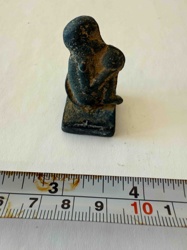
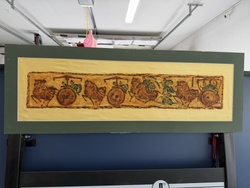
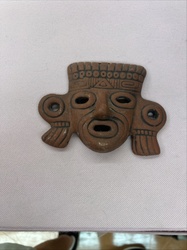
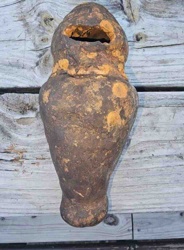
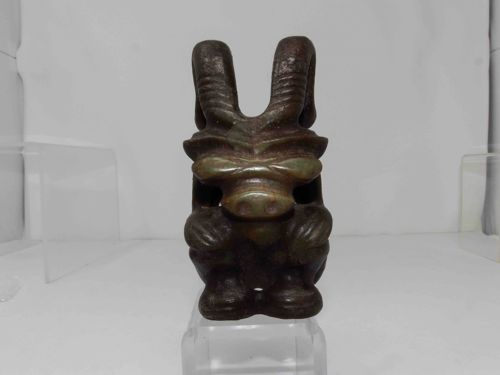
This small-scale carving represents a characteristic zoomorphic or anthropomorphic figure associated with the Neolithic Hongshan culture (c. 4700–2900 BC). The piece is carved from a stone that appears to be nephrite or a similar jadeoid material, displaying a weathered, dark olive-brown to russet patina with lighter greenish highlights visible on the protruding brow and snout areas. The figure is squat and stylized, featuring prominent, horizontally-stretched almond-shaped eyes, a flattened snout with incised nostrils, and two large, ribbed vertical horns or ears that extend upward from the head. The torso and limbs are compressed, with hands resting on the knees in a meditative or crouched posture. The carving exhibits 'ox-nose' style perforations commonly found in ancient Chinese amulets, used for suspension. The surface shows significant calcification, pitting, and ancient tool marks (likely wire-cut and abrasive techniques), which are indicators of age, though these can also be replicated in modern 'archaic style' reproductions. The proportions are balanced, reflecting significant skill in lapidary craftsmanship. There are no visible maker's marks, consistent with genuine prehistoric artifacts or their traditional copies. Condition appears stable with no major fractures, though the heavy surface calcification obscures much of the interior stone clarity.
Estimated Value

$400 - $800

Basic Information

Category

Ancient Asian Art & Antiquities

Appraised On

March 22, 2026

Estimated Value

$400 - $800

Additional Details Provided By Owner

User Provided Information

Unknown artist, untitled sculpture

Item Description

This small-scale carving represents a characteristic zoomorphic or anthropomorphic figure associated with the Neolithic Hongshan culture (c. 4700–2900 BC). The piece is carved from a stone that appears to be nephrite or a similar jadeoid material, displaying a weathered, dark olive-brown to russet patina with lighter greenish highlights visible on the protruding brow and snout areas. The figure is squat and stylized, featuring prominent, horizontally-stretched almond-shaped eyes, a flattened snout with incised nostrils, and two large, ribbed vertical horns or ears that extend upward from the head. The torso and limbs are compressed, with hands resting on the knees in a meditative or crouched posture. The carving exhibits 'ox-nose' style perforations commonly found in ancient Chinese amulets, used for suspension. The surface shows significant calcification, pitting, and ancient tool marks (likely wire-cut and abrasive techniques), which are indicators of age, though these can also be replicated in modern 'archaic style' reproductions. The proportions are balanced, reflecting significant skill in lapidary craftsmanship. There are no visible maker's marks, consistent with genuine prehistoric artifacts or their traditional copies. Condition appears stable with no major fractures, though the heavy surface calcification obscures much of the interior stone clarity.
Get Your Items Appraised

Instant estimates of your treasures with AI-powered instant appraisals

Browse More Appraisals