AI Appraisal Estimate

AI-generated estimates · not official valuations

From the user

What was submitted

Photo and notes provided by the user — not generated by AI

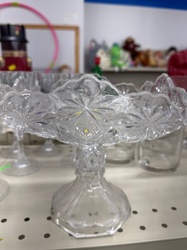
Submitted item photo
Submitted photo · June 17, 2026

User's notes

No additional notes provided.

AI analysis below

AI appraisal

AI analysis & estimate

AI-Generated · Verify before acting

Everything below is generated by AI for informational purposes only. AI can make mistakes — the AI may misidentify items or misattribute them (artist, maker, brand, designer, origin, era). This is not an official valuation and should not be used for insurance, sale, tax, estate, legal, or lending purposes — or any decision requiring a certified appraisal. It is not an authoritative claim about any person, brand, or rights holder — do not share or rely on it as a factual statement about a third party. Always consult qualified professionals before making financial decisions.

Read the full disclaimer

AI Identification

·Not independently authenticated·Verify before acting

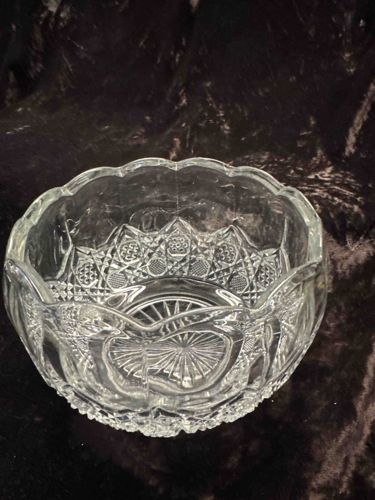
Early American Pattern Glass Hobstar and Fan Scalloped Bowl

Antique Glassware / Collectible Tableware

AI Estimated Value

·Not an official valuation·Verify before acting

$45.00 - $65.00

As of June 17, 2026

AI Item Analysis

·AI can make mistakes·Verify before acting
This is a circular, colorless glass bowl featuring a deeply pressed pattern in the 'Early American Pattern Glass' (EAPG) style, likely dating from the late 19th to early 20th century. The piece is constructed from heavy-gauge poured glass and showcases a scalloped or 'crenellated' rim that follows the curvature of the exterior molding. The primary decorative motif consists of large geometric hobstars alternating with fan and diamond point cuttings, a style popular during the American Brilliant period (circa 1880-1915). The base is finished with a large, integrated radial sunburst or multi-point star design. Physically, the glass exhibits a high degree of clarity with a slight yellowish or grayish cast typical of manganese or soda-lime glass from the era. The bowl's walls are thick and substantial, providing significant weight and durability. While no maker's mark is visible—which is common for EAPG—the craftsmanship shows uniform molding lines and crisp edges on the prismatic patterns. In terms of condition, the item appears to be in good vintage state, though there is a faint vertical line visible which may be a manufacturing mold seam rather than a crack. There are no obvious large chips or deep scratches visible on the upper rim, although minor 'flea bites' or base wear from surface contact are expected for an item of this age. This specimen represents a fine example of mass-produced decorative tableware designed to mimic more expensive lead crystal of the period.
AI Appraisal Report

·AI can make mistakes·Verify before acting
Based on my visual examination of this EAPG (Early American Pattern Glass) bowl, I have identified it as a high-quality example of 'pressed' glass rather than 'cut' crystal, typical of the American Brilliant period (circa 1890-1910). The 'Hobstar and Fan' motif is rendered with crisp, sharp edges, indicating a well-maintained mold. The presence of a visible mold seam and the slight yellowish/grayish tint confirm its composition as soda-lime glass, which was intended to mimic the more expensive leaded crystal of the era. The condition appears 'Good to Very Good' for its age; I noted the typical minor shelf wear on the base and 'flea bites' common to pressed glass, but no major structural compromising. Market demand for EAPG has softened over the last decade as younger collectors move away from formal tableware, though the 'Hobstar' pattern remains highly recognizable and collectible as a regional Americana staple. Comparable sales for similar diameter bowls (8-9 inches) without maker marks typically fall within the $40-$70 range. Please note: This appraisal is based solely on digital images. A definitive valuation would require an in-person 'black light' test to check for the fluorescence typical of manganese or uranium additives, as well as a physical 'ping' test to confirm the absence of internal heat cracks or lead content. Full authentication would also require cross-referencing against original manufacturer catalogs (e.g., US Glass or Fostoria) to pinpoint the specific pattern name and production year.

Get your items appraised

Instant estimates of your treasures with AI-powered appraisals

Browse More Appraisals