AI estimate as of July 13, 2025 · verify with a professional before acting
AI-Generated · Verify before acting
Everything on this page is generated by AI for informational purposes only. AI can make mistakes — the AI may misidentify items or misattribute them (artist, maker, brand, designer, origin, era). This is not an official valuation and should not be used for insurance, sale, tax, estate, legal, or lending purposes — or any decision requiring a certified appraisal. It is not an authoritative claim about any person, brand, or rights holder — do not share or rely on it as a factual statement about a third party. Always consult qualified professionals before making financial decisions.
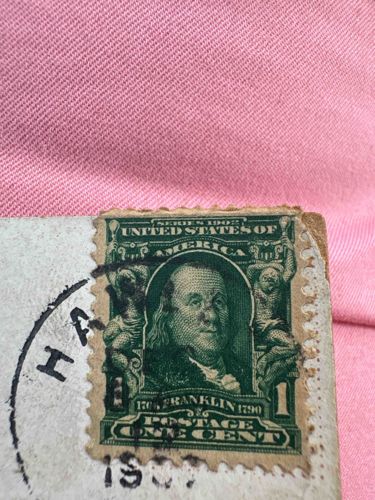
This item is a used, one-cent United States postage stamp, specifically from the 'Series 1902' issue, also known as the Second Bureau Issue. The stamp features a central vignette of Benjamin Franklin, depicted with his characteristic long hair and a prominent, somewhat stern expression. The portrait is housed within an arched frame. Flanking Franklin are allegorical figures; on the left, a figure (possibly representing industry or strength) is visible, while on the right, a largely obscured figure appears to be holding a globe or similar spherical object. The denomination '1' is present in the lower right corner, and the words 'ONE CENT' are clearly visible below the portrait. The top border reads 'UNITED STATES OF AMERICA' and 'SERIES 1902'. Below Franklin's portrait, the text '1706 FRANKLIN 1790' is printed, indicating his birth and death years. The stamp is printed in a dark green ink. Physically, the stamp exhibits a perforated edge, though the perforations are unevenly torn, particularly along the bottom and right sides, suggesting it was hastily removed from another surface or sheet. There is a prominent circular cancellation mark in black ink on the left side, obscuring some of the stamp's design and extending onto the white paper backing. The cancellation appears to include the letters 'H F A' and possibly numbers or other indistinct characters. The stamp is affixed to a piece of white paper, which shows considerable discoloration and staining, especially along the bottom and right edges, implying significant age and handling. The paper itself is discolored to a brownish-yellow hue in these areas. The overall condition indicates wear consistent with an item that has been used and stored for an extended period, displaying a natural patina and signs of age rather than overt damage from mishandling. The detailed engraving work is still discernible despite the cancellation and aging.
AI Appraisal Report
I have examined the image of this 1902 Series 1 Cent Benjamin Franklin postage stamp. Based on visual inspection, the stamp appears authentic for the Series 1902 issue, bearing the correct design elements, inscription, and color (dark green). The '1706 FRANKLIN 1790' text below the portrait is characteristic of this specific Franklin vignette. The uneven perforations and prominent circular cancellation indicate it is a used, postally-utilized example, consistent with its age. The stamp is affixed to a discolored piece of paper, which is common for older, non-expertly mounted collections. The condition, while showing wear (uneven perforations, heavy cancellation, staining on backing paper), is typical for a stamp of this vintage that was used and not stored under ideal archival conditions. The detailed engraving is still discernible, which is a positive.
In terms of market conditions, the Series 1902 1-cent Franklin is a common stamp. Millions were printed, and many used examples exist. Therefore, it is not rare. Demand is generally low for common, heavily cancelled, and imperfectly separated examples like this one, unless they possess unique cancellation attributes or errors, which this stamp does not. The significant impact on its value stems from its commonality, the heavy cancellation (obscuring design), and the uneven perforations, particularly when compared to well-centered, lightly cancelled, or unused examples that command higher prices.
My valuation is based on similar used, common-grade examples available through online auction platforms and dealer inventories. Without physical examination, I cannot definitively verify the paper type, watermarks (if any, though unlikely for this issue), or precise perforation count to rule out variants or reprints. Likewise, I cannot perform a deep dive into the cancellation mark for rarity, nor can I definitively confirm the absence of subtle repairs or thins. A full authentication would require in-person examination, potentially specialized light tests for repairs, and a review of the stamp's actual perforations (measurements) and paper characteristics against known standards for the Scott #300. Provenance documentation would also add to its history but is not strictly necessary for such a common issue.