AI estimate as of October 2, 2025 · verify with a professional before acting
AI-Generated · Verify before acting
Everything on this page is generated by AI for informational purposes only. AI can make mistakes — the AI may misidentify items or misattribute them (artist, maker, brand, designer, origin, era). This is not an official valuation and should not be used for insurance, sale, tax, estate, legal, or lending purposes — or any decision requiring a certified appraisal. It is not an authoritative claim about any person, brand, or rights holder — do not share or rely on it as a factual statement about a third party. Always consult qualified professionals before making financial decisions.
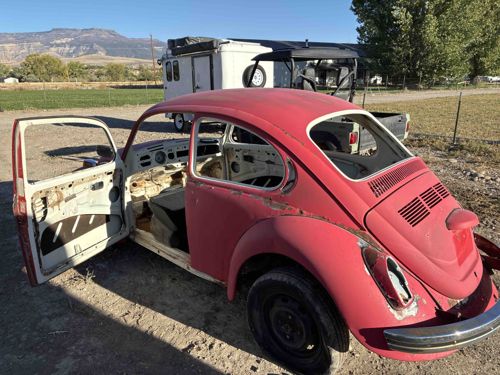
This item is a 1960s-era Volkswagen Beetle (Type 1), identified by its iconic rounded body, distinct sloping rear engine cover with air vents, and classic 'Bug' silhouette. The car is currently in a state of significant deconstruction, clearly intended as a restoration project. The exterior is finished in a faded, likely original, red (or possibly pinkish-red) paint, which shows extensive weathering, paint loss, and surface rust, particularly along seams, fender edges, and around the rear window frame. The passenger-side door is open, revealing a largely stripped interior. The dashboard appears to be mostly intact, including the instrument cluster opening, but all interior panels, seating, and upholstery have been removed. The driver's side door is also open, showing similar interior stripping. All windows, including the windshield and rear window, are missing. The vehicle is missing its headlights and taillight lenses; the rear taillight housings are present but empty, with signs of rust and previous bodywork/filler visible around them. The chrome bumpers, specifically the rear one, show significant pitting, rust, and likely some impact damage. The wheels are basic black steel rims, and the tires appear flat and in poor condition, indicative of long-term stationary storage. The overall condition suggests a vehicle in need of a full, ground-up restoration, exhibiting considerable wear, corrosion, and missing components. The lack of a motor is also highly probable given the state of the interior and exterior stripping. This is a classic example of a 'barn find' or a long-term project car.
AI Appraisal Report
I have visually examined the provided image of this 1960s-era Volkswagen Beetle (Type 1) project car. The authenticity as a Type 1 Beetle from that era appears verifiable by its iconic body shape, sloping engine cover, bumpers, and overall design cues. However, a full authentication of the specific year, trim, or any modifications would require reviewing the Vehicle Identification Number (VIN) and engine serial numbers, which are not visible in the image.
The condition is poor, indicative of a long-term, uncompleted restoration project or 'barn find.' The extensive surface rust, missing windows, stripped interior, and apparent absence of critical components like lights and possibly the engine significantly devalue the vehicle. Paint fade and loss are pervasive, and bodywork around the rear taillights suggests prior repairs or filler. The flat, deteriorating tires and basic steel wheels are consistent with a non-running, stationary vehicle. The open doors hint at the extent of the interior deconstruction.
Market conditions for early 'Bug' projects are generally stable, with strong demand for completed, high-quality restorations. However, for a project at this stage, the market is competitive, and buyers anticipate significant investment of time and money. Comparables for 'parts cars' or deeply involved projects like this typically range from a few hundred to a couple of thousand dollars, heavily dependent on the extent of rust and frame integrity. This particular example appears to be closer to the lower end due to the visible rust and missing components. Rarity is not a major factor for a standard Type 1 Beetle in this condition, as many were produced.
Factors significantly impacting value here are the unknown extent of structural rust (especially in the pan and heater channels), the missing engine and transmission (highly probable), and the sheer cost of parts and labor for a complete restoration. Without an in-person examination, I cannot confirm the chassis integrity, the presence/condition of the engine, transmission, or suspension components. Provenance documentation could add value if it were a rare or historically significant model, but for a standard Beetle project, its impact is usually minimal. Scientific testing would mainly be for material analysis if needed for a specific restoration approach.
Given its current state, this Beetle is essentially a canvas for a full restoration, or a source of panels for another project. My appraisal value reflects its status as a significant project car requiring substantial investment.