Southeast Asian Bronze Buddha Statue (Lower Section)
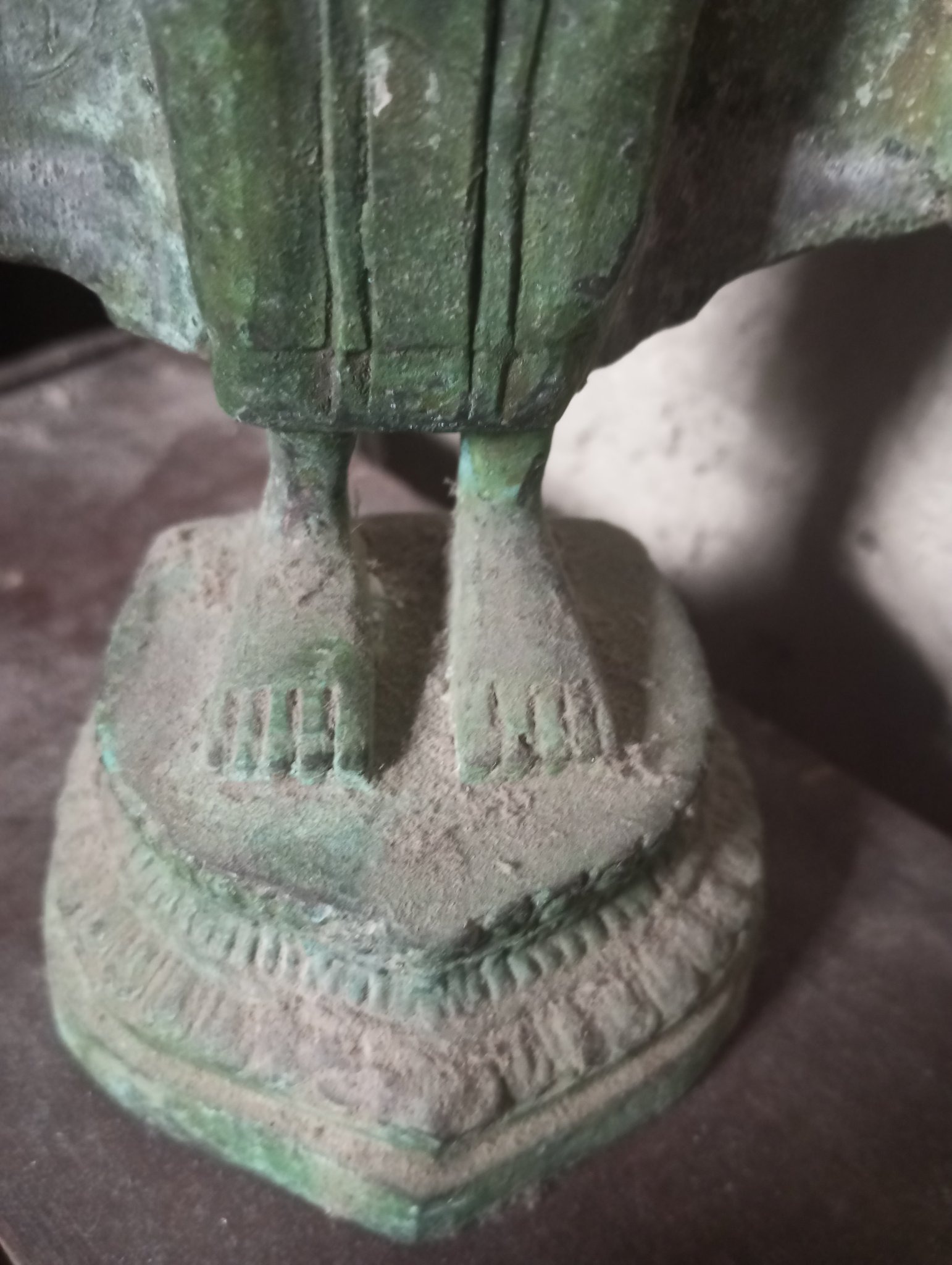
This item is the lower portion of a cast bronze religious figure, likely a standing Buddha or Buddhist deity, originating from Southeast Asia, possibly Thailand or Cambodia (Sukhothai or Ayutthaya style influence). The figure is standing on an elevated, tiered lotus-style base. The construction features heavy bronze casting with a prominent green verdigris patina across the entire surface, suggesting significant age or exposure to environmental moisture. The robe or 'antaravasaka' is visible, featuring vertical folds and crisp linear border details. The feet are depicted with simplified, blocky toes typical of specific regional casting traditions. Condition-wise, the piece shows heavy oxidation, dust accumulation, and surface pitting. No visible maker's marks are present on the exterior, which is common for such votive objects. The craftsmanship indicates a lost-wax casting technique, with the base exhibiting rhythmic, hand-tooled vertical notches to represent lotus petals. The overall aesthetic suggests a period piece, potentially late 19th to early 20th century, though the heavy encrustation requires further cleaning to confirm structural integrity.
AI-Generated Appraisal Disclaimer
Estimated Value
$400 - $700
Basic Information
Category
Art
Appraised On
May 2, 2026
Estimated Value
$400 - $700
Additional Details Provided By Owner
User Provided Information
Category: Art
Item Description
This item is the lower portion of a cast bronze religious figure, likely a standing Buddha or Buddhist deity, originating from Southeast Asia, possibly Thailand or Cambodia (Sukhothai or Ayutthaya style influence). The figure is standing on an elevated, tiered lotus-style base. The construction features heavy bronze casting with a prominent green verdigris patina across the entire surface, suggesting significant age or exposure to environmental moisture. The robe or 'antaravasaka' is visible, featuring vertical folds and crisp linear border details. The feet are depicted with simplified, blocky toes typical of specific regional casting traditions. Condition-wise, the piece shows heavy oxidation, dust accumulation, and surface pitting. No visible maker's marks are present on the exterior, which is common for such votive objects. The craftsmanship indicates a lost-wax casting technique, with the base exhibiting rhythmic, hand-tooled vertical notches to represent lotus petals. The overall aesthetic suggests a period piece, potentially late 19th to early 20th century, though the heavy encrustation requires further cleaning to confirm structural integrity.
Get Your Items Appraised
Instant estimates of your treasures with AI-powered instant appraisals