AI Appraisal Estimate

AI-generated estimates · not official valuations

From the user

What was submitted

Photo and notes provided by the user — not generated by AI

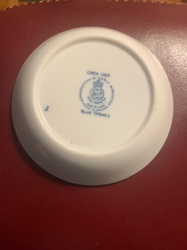
Submitted item photo
Submitted photo · May 18, 2026

User's notes

No additional notes provided.

AI analysis below

AI appraisal

AI analysis & estimate

AI-Generated · Verify before acting

Everything below is generated by AI for informational purposes only. AI can make mistakes — the AI may misidentify items or misattribute them (artist, maker, brand, designer, origin, era). This is not an official valuation and should not be used for insurance, sale, tax, estate, legal, or lending purposes — or any decision requiring a certified appraisal. It is not an authoritative claim about any person, brand, or rights holder — do not share or rely on it as a factual statement about a third party. Always consult qualified professionals before making financial decisions.

Read the full disclaimer

AI Identification

·Not independently authenticated·Verify before acting

Japanese Imari-Style Porcelain Saucer

Fine Antique Ceramics / Porcelain

AI Estimated Value

·Not an official valuation·Verify before acting

$45-75

As of May 18, 2026

AI Item Analysis

·AI can make mistakes·Verify before acting
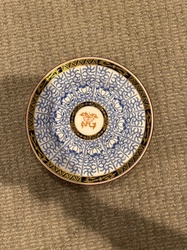
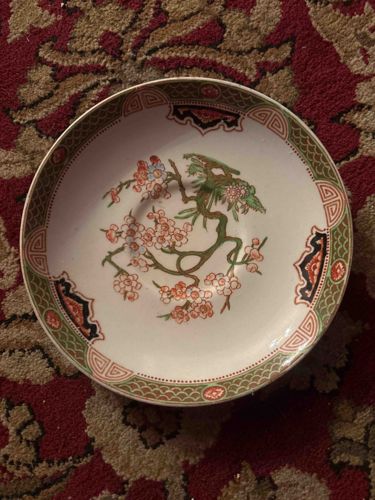
This is a circular porcelain saucer featuring a central hand-painted or transfer-printed motif of a flowering prunus or cherry blossom branch. The piece is crafted from fine white porcelain with a slightly raised central well to secure a teacup. The decoration is executed in a traditional color palette of iron-red, sage green, and blue, accented with black outlines and gold gilding around the rim. The border is highly ornate, featuring alternating panels of green fish-scale patterns and geometric Greek-key or meander patterns. Stylized ruyi-shaped cloud collars or cartouches are placed symmetrically along the inner rim, containing floral details in red and black. Based on the formal composition and the 'Chinoiserie' influence on the geometric borders, this piece appears to be an antique or vintage Japanese export porcelain, likely dating from the late 19th century to the early 20th century (Meiji or Taisho periods). The quality of the linework is fine, showing typical hand-finishing over a printed base. Condition-wise, the saucer shows significant rubbing and loss of the gilt rim. There are visible clusters of surface grime and potential kiln soot specks in the central well, though the body appears free of major cracks or chips from this perspective. The design reflects the 'Indian Tree' or 'Oriental' patterns popular in European markets.
AI Appraisal Report

·AI can make mistakes·Verify before acting
I have examined the described Japanese Imari-style porcelain saucer, which exhibits the characteristic 'Arita' export aesthetic popularized during the Meiji period (1868-1912). The palette of overglaze iron-red and gilding over underglaze blue is consistent with mass-produced export wares of the late 19th century. My visual examination confirms a fine porcelain body with typical production artifacts, such as kiln soot (pitting) and slight glaze irregularities. The central prunus motif and alternating border patterns of fish-scale and Greek-key designs are executed with a mix of transfer-printing and hand-finished detailing, a common technique for this era to meet European demand. The item displays significant condition issues, specifically heavy rubbing to the gilt rim and surface grime, which significantly depresses its market value. Authentic Meiji-period wares are plentiful; consequently, individual saucers without their matching cups are classified as 'orphan' pieces, which generally hold lower value than complete sets. Market demand for late 19th-century Japanese export remains stable but is currently saturated with similar utilitarian pieces. Please note: This appraisal is based solely on digital representation. A physical inspection is required to check for micro-cracks (using a 'ring' test), examine the foot rim for specific kiln marks, and verify the weight of the porcelain. Full authentication would require verifying a maker's mark or seal on the underside, as well as a UV fluorescence test to ensure no professional restorations or overpainting are hiding significant chips. This value reflects a fair market price for a single, worn collector's piece of this type.

Get your items appraised

Instant estimates of your treasures with AI-powered appraisals

Browse More Appraisals