Antique Natural History Hand-Colored Lithograph of Ring-Tailed Lemurs
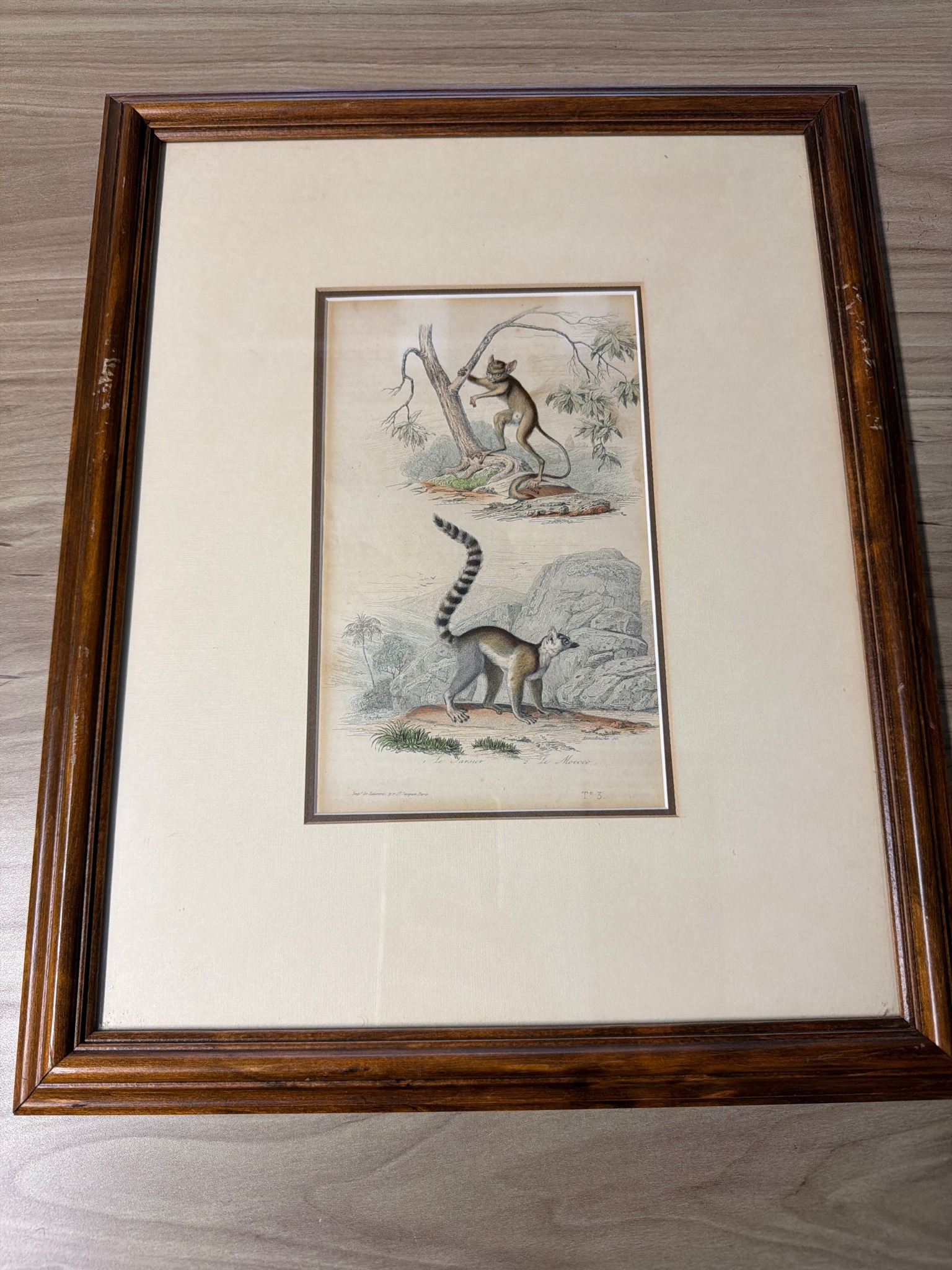
This item is an antique French natural history print depicting two primate species, most notably a Ring-Tailed Lemur (Le Mococo) and a smaller primate (Le Varier). The artwork is a hand-colored engraving or lithograph, likely dating from the mid-19th century. The print features fine line work and delicate watercolor tinting in shades of grey, tan, and green. It is housed in a contemporary dark wood frame with a double-beveled mat. Several markings are visible at the bottom edge: the printer's mark 'Impie. de Lemercier, r. de Seine, Paris' and the plate number 'T. 3.' indicative of its origin from a multi-volume scientific work. The paper exhibits signs of age-appropriate toning and minor foxing, particularly near the top edge of the visible print. The wood frame shows some mechanical scuffing and white paint transfer on the left and right outer edges, though the structural integrity remains sound. The composition showcases the animals in a stylized natural habitat, typical of the Romantic era's approach to zoological illustration, prioritizing aesthetic balance alongside anatomical detail.
AI-Generated Appraisal Disclaimer
Estimated Value
$75 - $150
Basic Information
Category
Antique Art and Prints
Appraised On
May 8, 2026
Estimated Value
$75 - $150
Item Description
This item is an antique French natural history print depicting two primate species, most notably a Ring-Tailed Lemur (Le Mococo) and a smaller primate (Le Varier). The artwork is a hand-colored engraving or lithograph, likely dating from the mid-19th century. The print features fine line work and delicate watercolor tinting in shades of grey, tan, and green. It is housed in a contemporary dark wood frame with a double-beveled mat. Several markings are visible at the bottom edge: the printer's mark 'Impie. de Lemercier, r. de Seine, Paris' and the plate number 'T. 3.' indicative of its origin from a multi-volume scientific work. The paper exhibits signs of age-appropriate toning and minor foxing, particularly near the top edge of the visible print. The wood frame shows some mechanical scuffing and white paint transfer on the left and right outer edges, though the structural integrity remains sound. The composition showcases the animals in a stylized natural habitat, typical of the Romantic era's approach to zoological illustration, prioritizing aesthetic balance alongside anatomical detail.
Related Tags
Explore similar items and categories:
Get Your Items Appraised
Instant estimates of your treasures with AI-powered instant appraisals