Framed Pears Soap Chromolithograph Print - 'Can’t You Talk?'
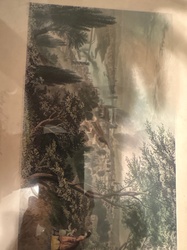
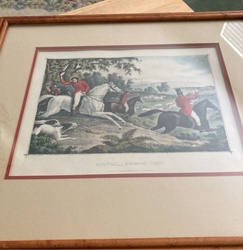
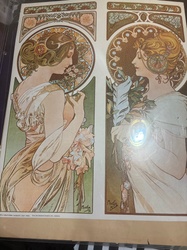
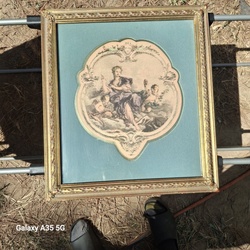
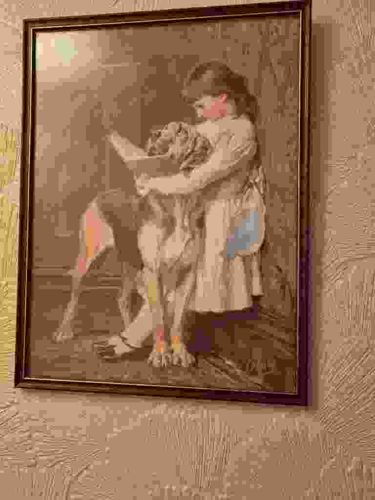
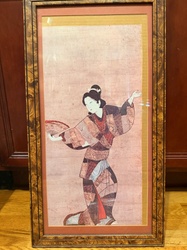
This item is a large-format framed print, likely a late 19th or early 20th-century chromolithograph. The work depicts a well-known Victorian sentimental scene often titled 'Can't You Talk?', originally by George Adolphus Storey and popularized as an advertisement for Pears Soap. It features a young girl in a white dress kneeling on a stone floor, leaning in to look at a large St. Bernard or similar mastiff-type dog face-to-face. The color palette is composed of muted sepia, cream, and earthy brown tones with subtle highlights. The print is housed in a dark wood or wood-veneer frame with a thin gold-toned inner fillet or liner. The construction suggests a commercial reproduction meant for home decor during the late Victorian or Edwardian eras. The overall condition appears fair to good for its age, though there is visible 'foxing' or discoloration consistent with paper oxidation. There are some minor light-damaged spots or surface abrasions, particularly on the dog's legs and the girl's face. The craftsmanship of the print demonstrates the high-quality lithographic techniques of the period, designed to mimic the texture and depth of an oil painting. No specific maker's marks are clearly visible in the image, but the style is quintessential of late 1800s advertising art.
AI-Generated Appraisal Disclaimer
Estimated Value
$150 - $250
Basic Information
Category
Antique Prints and Decorative Art
Appraised On
March 13, 2026
Estimated Value
$150 - $250
Item Description
This item is a large-format framed print, likely a late 19th or early 20th-century chromolithograph. The work depicts a well-known Victorian sentimental scene often titled 'Can't You Talk?', originally by George Adolphus Storey and popularized as an advertisement for Pears Soap. It features a young girl in a white dress kneeling on a stone floor, leaning in to look at a large St. Bernard or similar mastiff-type dog face-to-face. The color palette is composed of muted sepia, cream, and earthy brown tones with subtle highlights. The print is housed in a dark wood or wood-veneer frame with a thin gold-toned inner fillet or liner. The construction suggests a commercial reproduction meant for home decor during the late Victorian or Edwardian eras. The overall condition appears fair to good for its age, though there is visible 'foxing' or discoloration consistent with paper oxidation. There are some minor light-damaged spots or surface abrasions, particularly on the dog's legs and the girl's face. The craftsmanship of the print demonstrates the high-quality lithographic techniques of the period, designed to mimic the texture and depth of an oil painting. No specific maker's marks are clearly visible in the image, but the style is quintessential of late 1800s advertising art.
Related Tags
Get Your Items Appraised
Instant estimates of your treasures with AI-powered instant appraisals