AI estimate as of October 23, 2025 · verify with a professional before acting
AI-Generated · Verify before acting
Everything on this page is generated by AI for informational purposes only. AI can make mistakes — the AI may misidentify items or misattribute them (artist, maker, brand, designer, origin, era). This is not an official valuation and should not be used for insurance, sale, tax, estate, legal, or lending purposes — or any decision requiring a certified appraisal. It is not an authoritative claim about any person, brand, or rights holder — do not share or rely on it as a factual statement about a third party. Always consult qualified professionals before making financial decisions.
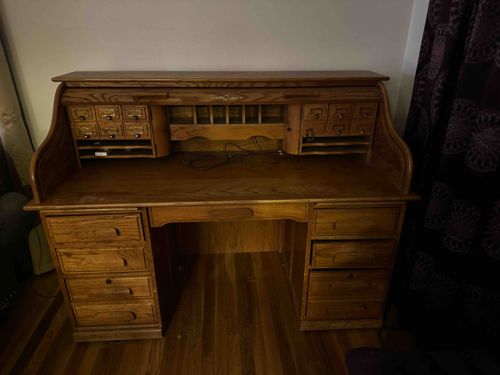
This is a classic roll-top desk, likely constructed from solid oak or an oak veneer over a composite wood, given its grain pattern and medium-brown stain. The desk features a traditional tambour door that rolls down to conceal the work surface and internal compartments. The overall dimensions appear to be substantial, suggesting a practical piece for a home office or study.
Physically, the desk presents a robust and traditional aesthetic. The coloring is a warm, natural wood tone, highlighting the grain of the oak. It is composed of a main desk base with a kneehole opening in the center, flanked by two pedestals of drawers. The left pedestal has four drawers, and the right pedestal has three drawers. All visible drawers have simple wooden knob pulls, suggesting a relatively common or mass-produced design. Above the main work surface, under the roll-top, there is an elaborate internal organization system. This includes two identical banks of six small dovetailed drawers each (totaling twelve tiny drawers), several pigeonholes for letters or documents, and a central shelf with a decorative, possibly carved, back panel. The small drawers in the upper section feature label holders with pulls, indicating their original use for organizing small items or cards.
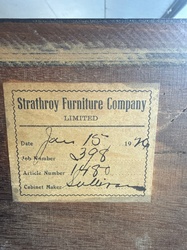
No significant damage, deep scratches, or repairs are immediately visible from the provided images, though the lighting is somewhat dim, which could obscure minor imperfections. The desk appears to be in good, used condition with a visible patina consistent with age and regular use. The finish shows some minor wear on the desktop surface, particularly in the central area, which is typical for a writing surface. The construction seems solid, a hallmark of this type of furniture. The style is distinctly traditional, likely dating from the late 20th century, probably between the 1970s and 1990s, when such roll-top desks were popular for home offices. There are no discernible manufacturer's marks or signatures visible in the images. The quality of craftsmanship appears to be good for a mass-produced item of its era, with functional joinery and a sturdy build.
AI Appraisal Report
Based on my visual examination of the provided image, this Oak Roll-Top Desk appears to be a good quality, mass-produced item likely from the late 20th century (1970s-1990s). The construction, showcasing traditional tambour door, kneehole design, and multiple drawers with wooden knob pulls, is typical of desks popular during that era for home offices. The internal organization system, with numerous small drawers and pigeonholes, is a practical and desirable feature.
The desk's condition appears good, with a visible patina consistent with age and regular use. I observe minor wear on the desktop, which is expected for a writing surface. No significant damage, deep scratches, or repairs are immediately apparent, though the dim lighting in the image could obscure minor imperfections. The material seems to be solid oak or a well-executed oak veneer. Authenticity as a mass-produced item from that period seems high based on design elements.
In terms of market conditions, roll-top desks from this era generally see moderate demand. While desirable for their classic aesthetic and functionality, they are not particularly rare. Given their substantial size, shipping costs or local pick-up limitations can impact realized value. Comparables for well-maintained, mass-produced oak roll-top desks in good condition typically fall within the $400-700 range on secondary markets.
Factors influencing value include the overall good condition, functional design, and classic appeal. The lack of discernible manufacturer's marks and its mass-produced nature prevent a higher valuation. For a full authenticity verification, an in-person examination would be crucial to assess material quality (solid wood vs. veneer), joint construction integrity, and to uncover any hidden damage or repairs that the image might not reveal. Provenance documentation, if available, would also aid in confirming its age and origin.